ERMITAGE DU SAINT CHRIST (LABASTIDA)

L’ermitage du Saint Christ se trouve dans la partie la plus élevée de Labastida et érigée sur une plate-forme en pierre robuste sur la colline de La Mota. Cette église-forteresse a ses origines au 12ème siècle, lorsque l’ermitage préroman original a été agrandi et renforcé, jusqu’à ce qu’il acquière son aspect actuel impressionnant. Diverses études archéologiques ont montré que le noyau d’origine à partir duquel la ville s’est développée a été établi ici.

Romane et gothique s’entremêlent. L’entrée principale est un bel exemple de roman, avec de délicats archivoltes et chapiteaux. À l’intérieur, les deux styles mentionnés peuvent être clairement distingués; le roman à l’arrière et le gothique avec des détails Renaissance sur la tête.

L’ermitage a été la paroisse de Labastida jusqu’en 1602. Le 14 avril de la même année, le Saint Sacrement a été transféré à l’église récemment inaugurée de Notre Dame de l’Assomption, qui sera, de ce jour jusqu’à aujourd’hui, la paroisse de la ville.

«L’ermitage du Saint Christ est un site important de dévotion et de spiritualité depuis des temps immémoriaux»

De génération en génération, la vénération et l’affection pour le Saint Christ de la ville ont été maintenues, et diverses légendes et miracles attribués à l’image du Saint Christ ont été transmis. On dit que, pendant une guerre, pour éviter que l’image ne soit endommagée ou outragée par les ennemis, elle a été enterrée dans un héritage et y a été oubliée. Au fil des ans, un berger a remarqué que ses moutons sautaient dans un petit espace où l’herbe grandissait et devenait plus forte, alors il a décidé de creuser à cet endroit et là, il a trouvé la figure du Saint Christ. De même, dans l’église, différentes toiles sont préservées qui relatent les nombreux miracles qui se sont produits par l’intercession du Saint Christ, tels que les guérisons physiques et spirituelles, ainsi que de nombreux autres événements surnaturels.

Après quelques coups de pinceau d’art et d’histoire, commençons la visite. Allez à la tête du temple en marchant lentement dans le couloir central. Si vous élevez votre regard, vous pourrez apprécier la structure gothique, admirable pour sa cohérence et sa sobriété. Sur la droite, il y a une réplique de la Vierge d’Estibaliz, patronne d’Alava, et sur votre gauche, les fonts baptismaux de l’ermitage où d’innombrables habitants de Labastida ont été baptisés. Au-dessus, il y a un beau Christ Crucifié, et puis une simple image de la Notre Dame du Mont-Carmel tenant l’Enfant Jésus dans ses bras.
«Venez à moi, vous tous qui êtes fatigués et chargés, et je vous donnerai du repos. Prenez mon joug sur vous et recevez mes instructions, car je suis doux et humble de cœur; et vous trouverez du repos pour vos âmes. Car mon joug est doux, et mon fardeau léger.»

Saint Matthieu 11, 28-30

Une fois que vous atteignez le transept du temple, sur la droite, vous pouvez voir le retable apporté du couvent disparu de Saint André de Muga. Il est présidé par la sculpture de la Vierge du Pilar. Dans la partie inférieure, vous pouvez distinguer différentes peintures: Sainte Catherine d’Alexandrie et Saint Jérôme à gauche de «La Cène» qui occupe la partie centrale. Les peintures à sa droite sont Sainte Marie Madeleine et Sainte Brigitte, l’un des six saints patrons d’Europe. L’ensemble est terminé par «La Sainte Trinité». Le Père est représenté comme un vieil homme couronné et le Fils, Notre Seigneur Jésus-Christ, est accompagné des symboles de la Passion. Les deux ont mis la main sur une sphère qui représente la terre. Parmi eux, le Saint-Esprit est représenté sous la forme d’une colombe. Une belle sculpture de l’Immaculée Conception occupe le simple retable adjacent.

Dans la nef opposée, il y a le retable présidé par l’image de Saint Antoine de Padoue. Il est l’un des rares saints représentés avec l’Enfant Jésus dans ses bras. Sur les côtés, vous pouvez voir les sculptures de Sainte Marie Madeleine et Saint François Xavier. Le grenier est occupé par une image de Sainte Barbe flanquée des plus petites sculptures de Saint Joachim et Saint Joseph, père et mari de la Vierge Marie respectivement. À ses côtés se trouve l’ancienne sculpture de Saint Roch qui montre les plaies sur sa jambe et est accompagnée d’un chien qui l’aide en cas de besoin extrême. Cet animal est un signe de providence et apparaît toujours dans l’iconographie du saint.

«Car Dieu a tant aimé le monde qu`il a donné son Fils unique, afin que quiconque croit en lui ne périsse point, mais qu`il ait la vie éternelle.»

Saint Jean 3, 16

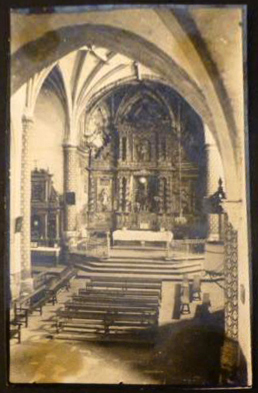
Vous pouvez maintenant voir le retable principal. Parmi de somptueuses colonnes salomoniques, l’image du Saint Christ, très aimé et vénéré, préside le tout. Cette curieuse image du Christ crucifié, d’une grande beauté et réalisme, est une sculpture gothique réalisée au XIIe siècle en bois polychrome et presque grandeur nature. Il a une grande dévotion dans la ville de Labastida.

La position de la main droite du Christ, décloué sur la croix, et celle de Joseph d’Arimathie, gravi les échelons de la «descente», est d’une extraordinaire originalité dans l’iconographie gothique. Des deux côtés, les sculptures de la Vierge Marie et de Saint Jean, le disciple bien-aimé, accompagnent le Christ crucifié dans une curieuse représentation du «Calvaire».

«Le soir étant venu, arriva un homme riche d’Arimathie, nommé Joseph, lequel était aussi disciple de Jésus. Il se rendit vers Pilate, et demanda le corps de Jésus. Et Pilate ordonna de le remettre. Joseph prit le corps, l’enveloppa d’un linceul blanc, et le déposa dans un sépulcre neuf, qu’il s’était fait tailler dans le roc. Puis il roula une grande pierre à l’entrée du sépulcre, et il s’en alla.»

Saint Matthieu 27. 57-60

La vénération du «Christ crucifié» est très courante dans le monde catholique. Le peuple fidèle a toujours su que la proclamation chrétienne est ancrée sur une croix. Sur la croix, Jésus nous a pardonné, nous a délivrés du péché et de la mort en donnant sa vie pour nous.

Et le triomphe définitif sur la mort vient avec la Résurrection. Pour cette raison, la majestueuse figure du Christ ressuscité couronne ce retable simple où se concentre le mystère de la foi. Le Rédempteur du monde donne la bénédiction de la main droite et de l’autre il tient un bâton, signe de sa royauté. De cette façon, il est souligné que Jésus est vivant et est notre Sauveur.

«Notre salut est un don du sang de Christ, tout est un don gratuit de Dieu et de son amour pour nous»

Tout est dit. Nous espérons que votre visite a été agréable. Avant de quitter le temple pour continuer votre voyage, nous vous invitons à passer un moment de prière solitaire aux pieds du Saint Christ.

Pour cela, nous mettons à votre disposition des prières qui peuvent vous aider dans ces moments de recueillement et de liens pour connaître la vie des saints dans les retables.


Evangile du jour. EVANGELIZO / ROSAIRE / VIA CRUCIS / VIA LUCIS

CELEBRATIONS EN L’HONNEUR DU SAINT CHRIST
Vendredi Saint
Notre Dame du Mont-Carmel
Saint Roch
Fête patronale d’action de grâce pour les Vendanges. Novembre.
MESSES
Samedis et veilles: 19h.
Dimanches et jours fériés: 12h.

PRIÈRE AU CHRIST DU CALVAIRE
Cet après-midi, Christ du Calvaire, je suis venu prier pour mon corps malade;
mais, quand je te vois, mes yeux vont et viennent de ton corps à mon corps avec honte.
Comment se plaindre de mes pieds fatigués, quand je vois les tiennes détruites?
Comment te montrer mes mains vides, quand les tiennes sont pleines de blessures?
Comment puis-je expliquer ma solitude, quand tu es seul sur la croix?
Comment puis-je t'expliquer que je n'ai pas d'amour quand ton cœur est déchiré?
Maintenant, je ne me souviens plus de rien, tous mes maux se sont enfuis.
L'impulsion de la demande que j'apportais se noyait dans ma bouche.
Et je demande seulement de ne rien vous demander, d’être ici, à côté de votre image morte,
apprendre que la douleur n'est que la clé sacrée de votre porte sacrée. Amen.

PRIÈRE AU CHRIST CRUCIFIÉ
Je viens à tes pieds humblement et en regardant ton image sacrée,
mon pauvre cœur est réconfortant et reprend son souffle
au milieu de l'amertume intime de ma vie.
Jésus, tes pieds sont cloués pour m'attendre toujours.
Tu as les bras étendus, pour me recevoir au moment qui arrive.
Tu as la tête penchée pour me regarder et me donner le baiser de rédemption
sans évoquer ma fragilité.
Tu as un cœur ouvert à verser dans le mien,
humain et plein de souffrance immense, les grâces que j'ai besoin.
Seigneur Jésus, pour ton immense angoisse, aie pitié de moi,
prends pitié de moi et accorde-moi les grâces que je te confie
pour t'implorer de ton infinie miséricorde:
Jésus Crucifié! Parce que tu es mon Roi et mon Seigneur
et l'ami qui ne manque jamais, aie pitié de mes larmes,
viens à mon aide et soulage les douleurs
qui me détresse. Amen.

HERMITAGE OF HOLY CHRIST (LABASTIDA)

The hermitage of Holy Christ is in the highest part of Labastida and erected on a robust stone platform on the hill of La Mota. This church-fortress has its origins in the 12th century, when the original pre-Romanesque hermitage was enlarged and reinforced, until it acquired the impressive appearance that it has today. Various archaeological studies have shown that the original nucleus from which the town developed was established at this point.

Romanesque and Gothic intermingle. The main façade is a beautiful sample of Romanesque, with delicate archivolts and capitals. Inside, the two mentioned styles can be clearly distinguished; the Romanesque on the back and the Gothic with Renaissance details on the head.

The hermitage was the parish of Labastida until 1602. On April 14 of that year, the Blessed Sacrament was transferred to the recently inaugurated church of Our Lady of the Assumption, to be, from that day until today, the town’s parish.

The hermitage of Holy Christ has been an important site of devotion and spirituality for centuries

From generation to generation, veneration and affection for the Holy Christ of the town has been maintained, and various legends and miracles attributed to the image of the Holy Christ have been transmitted. It is said that, during a war, to prevent the image from being damaged or outraged by the enemies, it was buried in an inheritance and was forgotten there. Over the years, a shepherd noticed that his sheep jumped in a small space where the grass grew taller and stronger, so he decided to dig in the place and there he found the figure of the Holy Christ. Likewise, in the church different canvases are preserved that relate the numerous miracles that occurred through the intercession of the Holy Christ, such as physical and spiritual healings, in addition to many other supernatural events.

After a few brushstrokes of art and history, let’s start the visit. Go to the head of the temple slowly walking down the central corridor. If you raise your gaze, you can appreciate the Gothic structure, admirable for its coherence and sobriety. On the right, there is a replica of the Virgin of Estibaliz, patron saint of Alava, and on your left, there is the baptismal font where countless inhabitants of Labastida have been baptized. Above it, there is a beautiful Crucified Christ and next, a simple carving of the Our Lady of Mount Carmel holding the Child Jesus in her arms.

If you are tired from carrying heavy burdens, come to me and I will give you rest. Take the yoke I give you. Put it on your shoulders and learn from me. I am gentle and humble, and you will find rest. This yoke is easy to bear, and this burden is light

St. Matthew 11, 28-30

Once you reach the temple transept, on the right, you can see the altarpiece brought from the disappeared convent of Saint Andrew of Muga. It is chaired by the carving of the Our Lady of the Pillar. In the lower part you can distinguish different paintings: Saint Catherine of Alexandria and Saint Jerome to the left of «The Last Supper» that occupies the central part. The paintings on his right are Saint Mary Magdalene and Saint Bridget, one of the six patron saints of Europe. The set is finished off by «The Holy Trinity». The Father is represented as a crowned old man and the Son, Our Lord Jesus Christ, is accompanied by the symbols of the Passion. Both put their hands on a sphere that represents the earth. Among them, the Holy Spirit is represented in the form of a dove. A beautiful carving of the Immaculate Conception occupies the simple adjacent altarpiece.

In the opposite nave, there is the altarpiece presided over by the image of Saint Anthony of Padua. He is one of the few saints who are represented with the Child Jesus in his arms. On the sides you can see the carvings of Saint Mary Magdalene and Saint Francis Xavier. Meanwhile, the attic is occupied by an image of Saint Barbara flanked by the smaller carvings of Saint Joachim and Saint Joseph, father and husband of the Virgin Mary respectively. At his side is the ancient carving of Saint Roch that shows the sores on his leg and is accompanied by a dog that helps him in times of greatest need. This animal is a sign of providence and always appears in the saint’s iconography.

God loved the people of this world so much that he gave his only Son, so that everyone who has faith in him will have eternal life and never really die

St. John 3, 16

Now you can see the main altarpiece. Among sumptuous Solomonic columns, the image of the Most Holy Christ, much loved and venerated, presides over the whole. This curious image of the Crucified Christ, of great beauty and realism, is a Gothic carving made in the 12th century in polychrome wood and almost life-size. It has a great devotion in the town of Labastida.

The position of the right hand of the Christ, pulled out the nails from the cross, and that of Joseph of Arimathea, climbed the ladder for the «Descent», is of extraordinary originality in the Gothic iconography. On both sides, the carvings of the Virgin Mary and of Saint John, the beloved disciple, accompany the crucified Christ in a peculiar representation of «Calvary».

That evening a rich disciple named Joseph from the town of Arimathea went and asked for Jesus’ body. Pilate gave orders for it to be given to Joseph, who took the body and wrapped it in a clean linen cloth. Then Joseph put the body in his own tomb that had been cut into solid rock and had never been used. He rolled a big stone against the entrance to the tomb and went away

St. Matthew 27. 57-60

Veneration of «Christ Crucified» is very common throughout the Catholic world. The faithful people have always known that the Christian proclamation is anchored on a cross. In it, Jesus forgave us, freed us from sin and death by giving his life for us.

And the definitive triumph over death comes with the Resurrection. For this reason, the majestic figure of the Risen Christ crowns this simple altarpiece in which the mystery of the Faith is concentrated. The Redeemer of the world imparts the blessing with his right hand and in the other he holds a staff, a sign of his royalty. In this way, it is emphasized that Jesus is alive and is our Saviour.

Our salvation is a gift of the blood of Christ; everything is a free gift from God and his love for us

All is said. We hope your visit has been pleasant. Before leaving the temple to continue your journey, we invite you to have a time of solitary prayer at the feet of the Holy Christ.

For this, we put at your disposal prayers that can help you in these moments of recollection and links to know the life of the Saints in the altarpieces.


Gospel of the day. EVANGELIZO / ROSARY / VIA CRUCIS / VIA LUCIS

FESTIVITIES IN HONOUR OF THE HOLY CHRIST
Holy Friday
Our Lady of Mount Carmel
Saint Roch
Thanksgiving festivities for the grape harvest. November.
MASSES
Saturdays and eve days: 19.00
Sundays and holidays: 12.00

PRAYER TO THE CHRIST OF CALVARY
On this afternoon, Christ of Calvary, I came to pray for my sick body;
but, when I see you, my eyes come and go from your body to my body with shame.
How to complain about my tired feet, when I see yours destroyed?
How to show you my empty hands, when yours are full of wounds?
How to explain to you my loneliness, when on the cross, you are lifted up and alone?
How can I explain to you that I do not have love, when your heart is torn?
Now I do not remember anything, all my ailments fled.
The impetus of the request that it brought disappears in the mouth of the beggar.
And I only ask not to ask you anything, to be here, next to your dead image,
to learn that pain is only the holy key of your holy door. Amen.

PRAYER TO CRUCIFIED CHRIST
I arrive at your feet humbly and when I look at your sacred image,
my poor heart is full of comfort and regains breath
in the midst of the intimate bitterness of my life.
Jesus, you have your feet nailed to wait for me always.
The extended arms receive me at the time that arrives.
The head inclined to look at me and give me the kiss of redemption
without making an evocation of my fragility.
The open heart to pour into mine,
human and full of immense suffering, the graces I need.
Lord Jesus, for your immense anguish, have mercy on me,
feel sorry for me and grant me thanks
that I implore of your infinite mercy:
Crucified Jesus! Because you are my King and Lord
and the friend who never fails, have mercy on my tears,
come to my aid and alleviate the pains
that so distress me. Amen.

KRISTO SANTUAREN ERMITA (BASTIDA)

Bastidako lekurik garaienean eta Motako muinoan dagoen harrizko plataforma sendoaren gainean eraikita, Kristo Santuaren ermita dago. Eliza-gotorleku honek XII. mendean du jatorria, antzinako ermita prerromanikoa zabaldu eta indartu zenean, gaur egungo itxura ikusgarria hartu arte. Hainbat ikerketa arkeologikok erakutsi dute puntu honetan jatorrizko gunea sortu zela geroago hiribildua garatzeko.

Erromanikoa eta gotikoa nahasten dira. Portada nagusia erromanikoaren erakusgarri ederra da, arkibolta eta kapitel delikatuekin. Barrualdean argi eta garbi bereiz daitezke aipatutako bi estiloak: erromanikoa atzealdean eta gotikoa burualdean xehetasun errenazentistekin.

Ermita Bastidako parrokia izan zen 1602 arte. Urte hartako apirilaren 14an, Sakramentu Santua Jasokundeko Andre Mariaren eliza ireki berrira lekualdatu zen, egun hartatik gaur arte herriko parrokia izateko.

Kristo Santuaren ermita debozio eta espiritualtasun leku garrantzitsua izan da antzina-antzinatik

Belaunaldiz belaunaldi, herriko Kristo Santuaren gurtza eta maitasuna mantendu da eta Kristo Santuaren irudiari egotzitako hainbat elezahar eta mirari transmititu dira. Esaten denez, gerra batean, etsaiek irudia kaltetu edo iraindu ez zezaten, lur sail batean lurperatu zen, eta han ahaztuta geratu zen. Urteak igaro ondoren, artzain batek bere ardiak paketean salto egiten ari zirela nabaritu zuen, belarra altuago eta indartsuago hazten zen leku txiki batean. Beraz, bertan zuloa egitea erabaki zuen, eta han aurkitu zuen Kristo Santuaren irudia. Era berean, tenpluan, Kristo Santuaren bitartekaritzagatik gertatutako mirari ugariak kontatzen dituzten oihal ezberdinak kontserbatzen dira, osasun fisiko eta espiritualak kasu, naturaz gaindiko beste hainbat gertakariez gain.

Arte eta historia pintzelkada batzuen ondoren, has dezagun bisita. Joan zaitez tenpluaren burualderantz, erdiko korridorea astiro zeharkatuz. Zure begirada goratzen baduzu, egitura gotikoa ikus dezakezu, bere koherentzia eta soiltasunagatik miresgarria. Eskuinean, Arabako zaindaria den Estibalizko Ama Birjinaren erreplika bat dago, eta, zure ezkerrean, ermitako bataiarria dago, non Bastidako hainbat eta hainbat herritar bataiatu dituzten. Bere gainean Kristo Gurutziltzatu eder bat dago eta, jarraian, Jesus Haurra besoetan eusten duen Karmengo Amaren irudi xume bat.

Zatozte niregana, nekatu eta zamatu guztiok, eta neuk emango dizuet atseden. Hartzazue nire uztarria eta ikasi niregandik, gozoa eta bihotz-apala bainaiz ni, eta aurkituko duzue bizitzarako atsedena; eramanerraza baita nire uztarria eta arina nire zama

San Mateo 11, 28-30

Tenpluko gurutzadurara iritsitakoan, eskuinetara, desagertutako Mugako San Andres komentutik ekarritako erretaula ikus dezakezu. Pilareko Ama Birjinaren tailua du buru. Behealdean margo ezberdinak bereiz ditzakezu: Alexandriako Santa Katalina eta San Jeronimo “Afariaren” ezkerrean, erdiko zatian dagoena. Bere eskuineko margoak Santa Maria Magdalena eta Santa Brigida dira, Europako sei santu patroietako bat. Multzo osoa errematatuz, «Hirutasun Santua». Aita agure koroatu bat bezala irudikatzen da eta Semea, Jesukristo Gure Jauna, Pasioaren ikurrekin batera dago. Biek eskuak jartzen dituzte lurra irudikatzen duen esfera baten gainean. Bere artean, Espiritu Santua uso moduan irudikatuta dago. Sortzez Garbiaren tailu eder bat dago alboko erretaula xumea.

Beste nabean, Paduako San Antonioren irudia duen erretaula dago. Jesus Haurra besoetan duela irudikatzen den santu bakarrenetakoa da. Alboetan, Santa Maria Magdalena eta San Frantzisko Xabierkoaren tailuak ikus ditzakezu. Bitartean, atikoan Santa Barbararen irudi bat dago, alboetan neurri txikiagoko eskulturak dituela: San Joakin eta San Jose, Ama Birjinaren aita eta senarra. Bere ondoan, San Rokeren antzinako tailua dago, bere hankako zauriak erakusten dituena, eta behar handieneko uneetan laguntzen zion txakur batekin. Animalia hau probidentziaren zeinua da eta beti agertzen da santuaren ikonografian.

Izan ere, Jainkoak hain maite izan zuen mundua, non bere Seme bakarra eman baitzion, harengan sinesten duenik inor gal ez dadin, baizik betiko bizia izan dezan

San Joan 3, 16

Orain erretaula nagusia ikus dezakezu. Zutabe salomoniko aberatsen artean, Kristo Santua, oso maitatua eta gurtua, da multzoaren buru. Kristo Gurutziltzatuaren irudi bitxi hau, edertasun eta errealismo handikoa, XII. mendean egur polikromatuan egindako tailu gotiko bat da, neurri ia naturalekoa. Debozio handia du Bastidan.

Kristoren eskuineko eskuaren jarrerak, gurutzetik iltzeak aterata, eta Arimateako Joserenak, gurutzetik eraisteko eskailerara igota, aparteko originaltasuna dute ikonografia gotikoan. Alde banatan, Ama Birjinaren eta San Joanen, maite duen dizipulua, irudiek laguntzen diote Kristo gurutziltzatuari «Kalbarioaren» irudikapen berezi batean.

Ilunabarrean, Jose zeritzan Arimateako gizon aberats bat etorri zen, Jesusen ikaslea. Pilatogana aurkeztu eta Jesusen gorpua eskatu zion. Pilatok emateko agindu zuen. Josek, gorpua harturik, izara garbi batean bildu zuen eta haitzean zulaturiko hilobi berri batean ezarri. Gero, harri handi bat irauliz, hilobiko sarrera itxi eta joan egin zen

San Mateo 27. 57-60

Mundu katoliko osoan oso ohikoa da «Kristo Gurutziltzatua» gurtzea. Herri leialak beti jakin izan du kristau iragarpena gurutze batean ainguratuta dagoela. Bertan, Jesusek barkatu egin gintuen, bekatutik eta heriotzatik libratu gintuen, gure alde bizia emanez.

Eta heriotzaren behin betiko garaipena Berpizkundearekin dator. Horregatik, Kristo berpiztuaren tailu dotoreak erretaula xume hau koroatzen du, non fedearen misterioa kontzentratzen den. Munduaren Berrerosleak bedeinkapena bere eskuineko eskuarekin ematen du, eta, bestean, makila bat dauka, bere erregetzaren ikurra. Horrela, Jesus bizirik dagoela eta gure Salbatzailea dela azpimarratzen da.

Gure salbazioa Kristoren odolaren oparia da, dena da Jainkoaren eta gureganako maitasunaren doako dohaina

Dena esanda dago. Espero dugu zure bisita atsegina izatea. Zure bideari jarraitzeko tenplua utzi baino lehen, Kristo Santuaren oinetan otoitz tarte bat bakardadean izatera gonbidatzen zaitugu.

Horretarako, barneratze-une hauetan lagungarri izan daitezkeen otoitzak eta erretaulak osatzen dituzten santuen bizitzan sakontzeko estekak jartzen ditugu zure eskura.


Eguneko ebanjelioa. EVANGELIZO / ARROSARIOA / GURUTZE-BIDEA / VIA LUCIS

KRISTO SANTUAREN OHORETAKO JAIAK
Ostiral Santua
Karmengo Ama
San Roke
Mahats-bilketaren esker oneko herriko jaiak. Azaroa.
MEZAK
Larunbat eta bezperak: 19:00
Igande eta jaiegunak: 12:00

KALBARIOAREN KRISTOAREN OTOITZA
Arratsalde honetan, Kalbarioaren Kristoa, nire gorputz gaixoagatik zu erregutzera nator;
baina, ikusten zaitudanean, nire begiak doazen eta datozen zure gorputzetik nirera lotsaz.
Nola kexa naiteke nire oin nekatuez, zureak ikusten ditudanean suntsituta?
Nola erakuts diezazkizuket nire esku hutsak, zureak zauriez beteta daudenean?
Nola azal diezazuket nire bakardadea, bakarrik zaudenean gurutzean?
Nola azal diezazuket ez dudala maitasunik, bihotza duzunean urratuta?
Orain ez naiz ezer oroitzen. Nire gaitz guztiak joan ziren.
Ekartzen zuen eskariaren oldarra aho miauan desagertzen da.
Eta zuri ezer ez eskatzea eskatzen dut soilik, hemen egotea, zure irudi hilaren ondoan,
ikastea mina zure ate santuko giltza santua dela. Amen.

KRISTO GURUTZILTZATUAREN OTOITZA
Nire Jainkoak, ez nau mugitzen zu maite izateko 
aginduta didazun zeruak, 
ez nau mugiarazten infernu hain beldur izanak
mintzeari uzteko.

Zuk, Jauna, mugitzen duzu mugi iezadazu zu ikustea 
gurutze batean iltzatuta eta irainduta, 
mugitzen du zure gorputz hain zaurituta ikustea, 
zure irainak eta zure heriotza mugitzen dizkit.

Laburbilduz, mugitzen du zure maitasuna, eta halako moduan, 
nahiz eta zerurik ez egon, nik maite zintzadala, 
eta nahiz eta infernurik ez egon, beldur zedin.

Maite zaituelako ez nauzu eman behar, 
nahiz eta itxaroten dudanak ez itxaron,
nahi dizudan berak maite izango zintuzke.
Amen.

ERMITA DEL SANTO CRISTO (LABASTIDA)

En la parte más elevada de Labastida, erigida sobre una robusta plataforma de piedra en el cerro de la Mota, se encuentra la ermita del Santo Cristo. Esta iglesia-fortaleza tiene sus orígenes en el siglo XII, cuando la primitiva ermita prerrománica fue ampliada y reforzada, hasta adquirir el impresionante aspecto que tiene en la actualidad. Diversos estudios arqueológicos han demostrado que en este punto se constituyó el núcleo original a partir del cual se desarrolló la villa.

Románico y gótico se entremezclan. La portada principal es un bello ejemplo de románico, con delicadas arquivoltas y capiteles. En el interior se pueden diferenciar claramente los dos estilos mencionados; el románico en la parte posterior y el gótico con retoques renacentistas en la cabecera.

La ermita en la que te encuentras fue la parroquia de Labastida hasta el año 1602. El 14 de abril de dicho año, se trasladó el Santísimo Sacramento a la recién inaugurada Iglesia de Nuestra Señora de la Asunción, siendo desde aquel día hasta hoy, parroquia de la villa.

“La ermita del Santo Cristo es un relevante emplazamiento de devoción y espiritualidad desde tiempo inmemorial”

De generación en generación, se ha mantenido la veneración y cariño al Santo Cristo de la villa, y se han transmitido diversas leyendas y milagros atribuidos a la imagen del Santo Cristo. Se cuenta que, durante una guerra, para evitar que la imagen fuera dañada o ultrajada por los enemigos, se enterró en una heredad y quedó allí olvidada. Pasados los años, un pastor que estaba con su rebaño notó que sus ovejas saltaban al pacer en un pequeño espacio donde la hierba crecía más alta y fuerte, por lo que decidió cavar en el lugar y allí encontró la figura del Santo Cristo. Asimismo, en la iglesia se conservan diferentes lienzos que relatan los numerosos milagros ocurridos por la intercesión del Santo Cristo, tales como sanaciones físicas y espirituales, además de otros muchos hechos sobrenaturales.

Después de unas pinceladas de arte e historia comencemos nuestra visita. Dirígete hacia la cabecera del templo recorriendo pausadamente el pasillo central. Elevando tu mirada puedes apreciar la estructura gótica, admirable por su coherencia y sobriedad. A la derecha se encuentra una réplica de la Virgen de Estíbaliz, patrona de Álava y a tu izquierda está la pila bautismal de la ermita, donde han sido bautizados innumerables habitantes de Labastida. Sobre ella, un Cristo Crucificado de cuidada factura y, seguidamente una sencilla imagen de la Virgen del Carmen que sostiene al Niño Jesús en sus brazos.

“Venid a mí todos los que estáis cansados y agobiados, y yo os aliviaré. Tomad mi yugo sobre vosotros y aprended de mí, que soy manso y humilde de corazón, y encontraréis descanso para vuestras almas. Porque mi yugo es llevadero y mi carga ligera”

San Mateo 11, 28-30

Llegados al crucero del templo, a nuestra derecha, podemos advertir el retablo traído del desaparecido convento de San Andrés de Muga. Está presidido por la talla de la Virgen del Pilar. En el banco puedes distinguir distintas pinturas: Santa Catalina de Alejandría y San Jerónimo a la izquierda de “La Última cena” que ocupa la parte central y las de su derecha corresponden a la Magdalena y Santa Brígida, una de los seis santos patronos de Europa. Rematando el conjunto, “La Santísima Trinidad”. El Padre es representado como un anciano coronado y el Hijo, Nuestro Señor Jesucristo, está acompañado de los símbolos de la Pasión. Ambos posan sus manos sobre una esfera que representa a la tierra. Entre ellos, el Espíritu Santo está representado en forma de paloma. Una bella talla de la Inmaculada Concepción ocupa el sencillo retablo adyacente.

En la nave opuesta, se encuentra el retablo presidido por la imagen de San Antonio de Padua, uno de los pocos santos al que se le representa con el Niño Jesús en brazos. En los laterales distinguimos las tallas de Santa María Magdalena y San Francisco Javier, mientras que el ático está ocupado por una imagen de Santa Bárbara, flanqueada por las tallas de menores dimensiones de San Joaquín y San José, padre y esposo de la Virgen María respectivamente. A su lado se halla la antiquísima talla de San Roque que muestra las llagas de su pierna y es acompañado por un perro que le socorría en sus momentos de mayor necesidad. Este animal es signo de la providencia y siempre aparece incluido en la iconografía del santo.

“Porque tanto amó Dios al mundo que dio a su Hijo único, para que todo el que crea en Él no perezca, sino que tenga vida eterna”

San Juan 3, 16

Ahora es momento de contemplar el retablo mayor. Entre suntuosas columnas salomónicas, la tan querida y venerada imagen Santísimo Cristo preside el conjunto. Esta singular imagen de Cristo Crucificado, de gran belleza y realismo, es una talla gótica realizada en el siglo XII en madera policromada y de tamaño casi natural. Goza de una gran devoción en la villa de Labastida.

Las posturas de la mano derecha del Cristo, ya desclavada de la cruz, y la de José de Arimatea subido a la escalera para el “Descendimiento” son de extraordinaria originalidad en la iconografía gótica. A ambos lados, las efigies de la Virgen María y de San Juan, el discípulo amado, acompañan a Cristo crucificado en una peculiar representación del “Calvario”.

“Al anochecer llegó un hombre rico de Arimatea, llamado José, que era también discípulo de Jesús. Este acudió a Pilato a pedirle el cuerpo de Jesús. Y Pilato mandó que se lo entregaran. José, tomando el cuerpo de Jesús, lo envolvió en una sábana limpia, lo puso en su sepulcro nuevo que se había excavado en la roca, rodó una piedra grande a la entrada del sepulcro y se marchó”.

San Mateo 27. 57-60

En todo el orbe católico es muy común la veneración a “Cristo Crucificado”. El pueblo fiel siempre ha sabido que el anuncio cristiano está anclado en una cruz. En ella Jesús nos redimió, nos libró del pecado y de la muerte dando su vida por nosotros.

Y el triunfo definitivo sobre la muerte llega con la Resurrección. Por ello, coronando este sencillo retablo donde se concentra el misterio de la Fe, contemplamos la majestuosa figura de Cristo Resucitado. El Redentor del mundo imparte la bendición con su diestra y con su otra mano sostiene un báculo, signo de su realeza. De este modo, se enfatiza que Jesús está Vivo y es nuestro Señor y Salvador.

“Nuestra salvación es un regalo de la sangre de Cristo, ya que todo es don gratuito de Dios y de su amor incondicional por nosotros”

Todo está dicho. Esperamos que tu visita haya sido grata. Antes de abandonar el templo para seguir tu camino, te invitamos a tener un rato de recogimiento y oración, en la soledad a los pies del Santo Cristo.

Para ello, ponemos a tu disposición varias oraciones que pueden ayudarte en estos momentos de interiorización y diversos enlaces para profundizar en la vida de los Santos que componen los retablos.


EVANGELIO DIARIO / ROSARIO / VIA CRUCIS / VIA LUCIS

FIESTAS EN HONOR AL SANTÍSIMO CRISTO
Viernes Santo
Virgen del Carmen
San Roque
Fiestas patronales de Acción de gracias de la Vendimia. Noviembre.
MISAS
Sábados y vísperas: 19:00h.
Domingos y festivos: 12:00h.

ORACIÓN AL CRISTO DEL CALVARIO
En esta tarde, Cristo del Calvario, vine a rogarte por mi carne enferma;
pero, al verte, mis ojos van y vienen de tu cuerpo a mi cuerpo con vergüenza.
¿Cómo quejarme de mis pies cansados, cuando veo los tuyos destrozados?
¿Cómo mostrarte mis manos vacías, cuando las tuyas están llenas de heridas?
¿Cómo explicarte a ti mi soledad, cuando en la cruz, alzado y solo estás?
¿Cómo explicarte que no tengo amor, cuando tienes rasgado el corazón?
Ahora ya no me acuerdo de nada, huyeron de mí todas mis dolencias.
El ímpetu del ruego que traía se me ahoga en la boca pedigüeña.
Y sólo pido no pedirte nada, estar aquí, junto a tu imagen muerta,
ir aprendiendo que el dolor es sólo la llave santa de tu santa puerta.
Amén.

ORACIÓN A CRISTO CRUCIFICADO
No me mueve, mi Dios, para quererte
el cielo que me tienes prometido,
ni me mueve el infierno tan temido
para dejar por eso de ofenderte.
 
Tú me mueves, Señor, muéveme el verte
clavado en una cruz y escarnecido,
muéveme ver tu cuerpo tan herido,
muévanme tus afrentas y tu muerte.
 
Muéveme, en fin, tu amor, y en tal manera,
que aunque no hubiera cielo, yo te amara,
y aunque no hubiera infierno, te quisiera.
 
No me tienes que dar porque te quiera,
pues aunque lo que espero no esperara,
lo mismo que te quiero te quisiera.

ÉGLISE DE SAINTE MARIE DE L’ASSOMPTION (LABASTIDA)

Cher visiteur, bienvenue à la ville de Labastida et à l’église de Sainte Marie de l’Assomption. Ce temple a été construit grâce à la foi profonde et à la grande dévotion des habitants de cette noble ville à Notre Dame. Au cours de ces siècles, elle a été visitée par d’innombrables voyageurs, marchands et pèlerins qui, en traversant Labastida, recherchaient des moments de paix et de prière.

Les travaux de construction du temple ont commencé au milieu du XVIe siècle. Comme c’était l’époque de la prospérité, les familles prospères de la ville ont favorisé sa construction. En avril 1602, lorsque la tête fut terminée et placée sous la consécration de Notre Dame de l’Assomption, le nouveau temple fut consacré avec le transfert du Saint Sacrement, de l’ancienne paroisse de Saint Christ située dans la partie la plus élevée de la ville. Le culte a commencé, bien que le temple ne soit pas terminé. Les travaux se poursuivent tout au long du XVIIe siècle avec la fermeture des toitures et la construction du retable principal, du chœur, des chapelles latérales et du clocher. L’ensemble du complexe fut achevé en 1671. Au début du XVIIIe siècle -1711-, la prospérité de la ville permit d’annexer la majestueuse sacristie octogonale.

En accédant au temple, vous pouvez voir l’imposant orgue baroque fabriqué par Juan de Tovar de Navarre en 1670. C’est un orgue loué par de nombreux organistes en raison de son excellente qualité musicale. Sous l’orgue, vous pouvez voir le simple retable de la fin de la Renaissance de Saint Joseph ou des Âmes dans lequel Saint Joseph tient l’Enfant Jésus dans ses bras, escorté par les sculptures de Saint Etienne l’Abbé et Saint Pierre. Les deux ont un médaillon sur la poitrine et sont des saints patrons de Labastida. Ces deux moines bénédictins appartenant aux Martyrs de Cardeña ont été massacrés par les armées musulmanes, ils ont donc été canonisés en 1603. Le relief des Âmes Bénies du Purgatoire couronne l’ensemble.

Comme vous pouvez le voir, des deux côtés du retable se trouvent les sculptures de procession de «la Flagellation» et de «Ecce Homo». Avec les cars de «la Dernière Cène», «Jésus avec la croix en remorque», «la prière du jardin» et «Christ couché» qui appartiennent à la Confrérie de la Sainte Croix des Frères Pénitents de la Ville. À Semaine Sainte, ils participent aux processions dans les rues de Labastida et sont une catéchèse parfaite qui nous rapproche de la Passion et de la mort de Notre Seigneur.

Maintenant, déplacez-vous vers la partie inférieure du chœur, à l’arrière du temple. Voici la Chapelle de la Solitude et met en valeur la voûte nervurée polychrome qui a des scènes de chérubins. Cette iconographie s’étend jusqu’aux murs avec les scènes du Couronnement et de la Descente. La Vierge des Douleurs préside la salle, provenant du couvent franciscain disparu de Saint Andrée de la Muga.

Avant de commencer la visite vers la tête du temple, sur votre droite, vous pouvez voir le baptistère où se trouvent les fonts baptismaux, séparé du reste du temple par une simple grille. Le Baptême est le fondement de la vie chrétienne. C’est le portique de la vie dans l’Esprit et la porte qui ouvre l’accès aux autres sacrements. Par le Baptême, nous sommes libérés du péché et régénérés en tant que Fils de Dieu, incorporés dans Son Église pour être membres du Christ.

«En vérité, en vérité, je te le dis, si un homme ne naît d’eau et d’Esprit, il ne peut entrer dans le royaume de Dieu.»

Saint  Jean 3, 5

Maintenant, allez à la tête du temple par le couloir central. Levez votre regard pour être conscient de la structure et de la monumentalité du temple. Sa plante est basilicale, avec une nef divisée en quatre sections. Les trois premiers sont couverts de voûtes circulaires à six branches, tandis qu’un imposant dôme, joliment décoré de fresques, occupe la dernière section.

À la tête du temple se trouve un ensemble extraordinaire composé du retable principal et des six retables collatéraux, de forme et de style identiques, qui composent un ensemble d’une grande beauté.

Commencez par les retables sur le mur de droite. Vous pouvez vous rapprocher d’eux pour les observer en détail. Le premier, situé dans le contrefort, est le Retable de Saint Christ des Remèdes dont la magnifique sculpture préside le complexe. Il a une grande dévotion, car le peuple a toujours compris que la Croix n’est pas une défaite, mais le prélude au triomphe définitif de la mort qui viendra avec la Résurrection. La partie supérieure est occupée par l’image de Sainte Barbe à côté de la tour qui l’accompagne toujours. Sainte Barbe diffère des autres martyrs chrétiens, car elle a été enfermée dans une tour éloignée et exécutée par son propre père.

De ce côté de l’Épître, une chaire dorée surmontée d’une sculpture de l’archange Saint Michel vous sépare de la section adjacente, où vous pouvez voir la Vierge Marie avec l’Enfant dans ses bras présidant le retable. Cette sculpture est accompagnée des images de Saint Joachim et Sainte Anne, parents de Marie et donc grands-parents de Jésus. La sculpture de Saint Jean Népomucène couronne le retable, tandis qu’au fond ou à la prédelle, vous pouvez distinguer l’image du grand prédicateur dominicain Saint Vincent Ferrier. À sa gauche se trouve le retable de Notre-Dame du Rosaire, dont l’effigie de traits fins et d’une grande sérénité occupe la niche centrale. Marie est représentée comme une jeune maman qui présente son fils et tend son bras droit en nous offrant son chapelet. Dans le haut du corps se trouve Saint Dominique de Guzman, fondateur des Dominicains.

«Ne savez-vous pas que vous êtes le temple de Dieu, et que l’Esprit de Dieu habite en vous?»

1 Corinthiens 3, 16

Il est maintenant temps de voir l’ensemble des trois retables situés à gauche, dans la nef de l’Évangile. Le premier d’entre eux est celui dédié à Saint Sébastien, dont la sculpture pleine de flèches le préside. Saint Sébastien était un martyr romain avec une grande dévotion dans le passé pour être le patron des mourants et protecteur contre la peste. Dans le grenier, la sculpture de Notre-Dame des Neiges couronne l’ensemble.

Avant d’atteindre la section suivante, vous pouvez voir la sculpture de Saint Isidore le Laboureur, saint patron des agriculteurs. La légende raconte que deux anges travaillaient avec leurs bœufs, pendant que notre saint priait.

Dans cette section, il y a le retable de l’Immaculée Conception, dont la délicate figure est escortée par les images de la reine Sainte Elizabeth de Hongrie et de Saint Louis, roi de France. Aux pieds de la Vierge, vous pouvez voir la sculpture de Saint Antoine de Padoue, l’un des rares saints qui est représenté avec l’Enfant Jésus dans ses bras. Pour terminer cet ensemble, vous pouvez voir la sculpture de Saint François Xavier, patron des Missions. À sa droite se trouve le retable de Saint Pierre, présidé par la sculpture papale couronnée de la tiare papale. Dans le haut du corps se trouve Saint Prudence, saint patron d’Alava.

«Notre salut est un don du sang de Christ. Tout est un don gratuit de Dieu et de son amour pour nous»

Après avoir découvert des thèmes et des figures que vous ne connaissiez peut-être pas lors de la visite du temple, il est temps de contempler l’extraordinaire retable principal de Notre Dame de l’Assomption, titulaire du temple. Pour l’admirer en détail et approfondir sa beauté, à la fois spirituelle et artistique, nous vous invitons à vous asseoir sur les bancs avant sous l’imposante coupole décorée de belles fresques, ainsi que les murs latéraux.

Ce majestueux retable de style baroque churrigueresque a été construit à la fin du XVIIe siècle, entre 1672 et 1691. Il a un banc, deux sections et un grenier, divisé en trois rues, à leur tour séparées par deux paires de colonnes salomoniques.

Commencez par le bas appelé la banque. La partie centrale est occupée par le Tabernacle. Pendant ce temps, à ses côtés, les reliefs incolores de «L’adoration des bergers à l’Enfant Jésus» et «L’Epiphanie» ou apparition du Seigneur aux Mages.

Dans la première partie, la belle sculpture de la Vierge de Toloño, également connue sous le nom de Notre Dame des Anges, est flanquée des sculptures de Saint Pierre et Saint Paul. Elle est une Vierge assise avec l’enfant sur ses genoux et vénérée comme la patronne de la ville.

Dans les frises-corniches de la partie centrale qui séparent cette première partie de la contiguë, il y a les petites sculptures des Quatre Évangélistes; Saint John, appelé l’aigle de Patmos; Saint Matthieu accompagné d’un ange; Saint Marc avec un lion et Saint Luc et le taureau. À l’extérieur, les sculptures des apôtres Saint Thomas et Saint Barthélemy.

Continuez avec la deuxième partie. Parmi les sculptures de Saint Jean et de Saint Jacques l’Apôtre et présidant l’ensemble, vous pourrez admirer la belle et délicate image de l’Assomption de Marie, à qui ce temple est consacré. La sculpture représente le moment où la Vierge Marie, à la fin de sa vie terrestre, est emmenée au ciel corps et âme. Six anges l’élèvent vers la gloire céleste.

Pour compléter cet ensemble extraordinaire, le groupe de sculptures de la «Sainte Trinité» se détache au centre de la coquille-grenier. Les trois images couronnent Marie comme reine du ciel. Le Père, représenté comme un vieillard couronné; le Fils, Jésus-Christ, le Verbe incarné et; parmi eux, la colombe représentant le Saint-Esprit. Des anges musicaux et des chérubins entourent la scène. Sur les côtés, il y a les sculptures des Archanges Saint Michel et Saint Gabriel.

La frise inférieure est occupée par les sculptures des docteurs de l’Église qui représentent le magistère de l’Église; Saint Augustin, Saint Grégoire le Grand, Saint Jérôme et Saint Ambroise, avec deux apôtres anonymes. Enfin, dans la partie inférieure de ce retable extraordinaire, le plus grand trésor que nous trouvons dans le temple, la Présence eucharistique du Seigneur dans le Tabernacle, semble passer inaperçu. Le Christ vivant nous a sauvés et rachetés, nous a donné la vie éternelle et est toujours à nos côtés. Il vous attend.

«Jésus est vivant parmi nous. Il est le même hier, aujourd’hui et pour toujours»

La visite se termine là où nous avons uni l’art et la foi. Nous souhaitons que ce soit agréable. Avant de quitter le temple pour continuer votre voyage à travers les terres de La Rioja Alavaise, nous vous invitons à avoir un moment de recueillement et de prière, à vous asseoir en silence devant la présence accueillante de Notre Mère méditant sur sa vie de dévouement et de gratitude ou à accompagner et à rendre gloire le Seigneur devant le Tabernacle.

Pour ce faire, nous vous proposons quelques prières qui peuvent être utiles et divers liens pour en savoir plus sur la vie des saints dans les retables.

«La prière est la force de l’homme et la faiblesse de Dieu»


EVANGILE DU JOUR / ROSARIE / VIA CRUCIS / VIA LUCIS

MESSES
Samedis et veilles: 19h.
Dimanches et jours fériés: 12h.
MEMORARE
Souvenez vous, ô très pieuse Vierge Marie,
qu’on a jamais entendu dire
qu’aucun de ceux qui ont eu recours à votre protection,
qui ont imploré votre secours et demandé vos suffrages,
ait été abandonné.
Animé d’une pareille confiance,
ô Vierge des vierges, ô ma Mère,
je viens à vous, et gémissant sous le poids de mes péchés,
je me prosterne devant vous.
Ô Mère du Verbe, ne méprisez pas mes prières,
mais écoutez les favorablement et daignez les exaucer. Amen.
 
SALVE REGINA
Salut, Reine, Mère de Miséricorde, notre Vie, notre Douceur, et notre espérance, salut.
Vers toi nous élevons nos cris, pauvres enfants d’Ève exilés.
Vers toi nous soupirons, gémissant et pleurant dans cette vallée de larmes.
Tourne donc, ô notre Avocate, tes yeux miséricordieux vers nous.
Et, Jésus, le fruit béni de tes entrailles, montre-le nous après cet exil.
Ô clémente, ô pieuse, ô douce Vierge Marie! Amen..

CHURCH OF ASSUMPTION OF MARY (LABASTIDA)

Dear visitor, welcome to the town of Labastida and its church of Assumption of Mary. This temple was built thanks to the deep faith and great devotion of the people of this noble town to Our Lady. During these centuries it has been visited by countless travellers, merchants and pilgrims who, on their way through Labastida, were looking for moments of peace and prayer.

The building works of the temple began in the middle of the 16th century. As these were times of prosperity, the thriving families of the town promoted its construction. In April 1602, when the head was finished and placed under the dedication of Our Lady of the Assumption, the new temple was consecrated with the transfer of the Blessed Sacrament, from the old parish of Holy Christ located in the highest part of the town. The worship began, although the temple was not finished. The works continued throughout the 17th century with the closing of the roofs and the construction of the main altarpiece, the choir, the side chapels and the bell tower. The entire complex was completed in 1671. At the beginning of the 18th century -1711-, the prosperity of the town allowed the annexation of the majestic octagonal sacristy.

Upon entering the temple you can see the imposing baroque organ made by Juan de Tovar from Navarre in 1670. It is an organ praised by many organists due to its excellent musical quality. Under the organ, you can see the simple late Renaissance altarpiece of Saint Joseph or of the Souls. In it, Saint Joseph holds the Child Jesus in his arms, being escorted by the carvings of Saint Stephen Abbot and Saint Peter. Both have a locket on their chests and are co-patrons of Labastida. These two Benedictine monks belonging to the Martyrs of Cardeñawere slaughtered by the Muslim armies, so they were canonized in 1603. The relief of the Blessed Souls in Purgatory crowns the whole.

As you can see, on both sides of the altarpiece are the procession carvings of “the Flagellation” and “Ecce Homo”. Along with the steps of «the Last Supper», «Jesus with the Cross in tow», «the Garden Prayer» and «Christ Lying» that belong to the Brotherhood of the Holy Cross of Penitent Brothers of the Town. At Holy Week they take part in the processions through the streets of Labastida and are a perfect catechism that brings us closer to the Passion and death of Our Lord.

Now move towards the lower part of the choir, at the back of the temple. Here is the Solitude Chapel and highlights the polychrome ribbed vault that has cherub scenes. This iconography extends to the walls with the scenes of the Coronation and the Descent. The Virgin of Sorrows presides over the room, coming from the disappeared Franciscan Convent of Saint Andrew of Muga.

Before starting the tour towards the head of the temple, on your right you can see the baptistery where the baptismal font is located, separated from the rest of the temple by a simple grille. Baptism is the foundation of the Christian life. It is the portico of life in the Spirit and the door that opens access to the other sacraments. By the Baptism we are freed from sin and regenerated as Sons of God, incorporated into His Church to be members of Christ.

«I tell you for certain that before you can get into God’s kingdom, you must be born not only by water, but by the Spirit.«

St.  John 3, 5

Now, go to the head of the temple through the central corridor. Raise your gaze to be aware of the structure and monumentality of the temple. Its plant is basilical, with a nave divided into four sections. The first three are covered with six-spoke circular vaults, while an imposing dome, beautifully decorated with fresco paintings, occupies the last section.

At the head of the temple, there is an extraordinary ensemble consisting of the main altarpiece and the six collateral altarpieces, identical in form and style, which make up a striking ensemble of great beauty.

Start with the altarpieces on the right wall. You can get closer to observe them in detail. The first, located in the buttress, is the Altarpiece of Holy Christ of Remedies whose magnificent carving presides over the complex. It has a great devotion, because the people have always understood that the Cross is not a defeat, but the prelude to the definitive triumph over death that will come with the Resurrection. The upper part is occupied by the image of Saint Barbara next to the tower that always accompanies him. Saint Barbara differs from other Christian martyrs, because she was locked in a distant tower and executed by her own father.

On this nave of the Epistle, a golden pulpit topped by a sculpture of the Archangel Saint Michael separates you from the adjacent section, where you can see the Virgin Mary with the Child in her arms presiding over the altarpiece. This carving is accompanied by the images of Saint Joachim and Sainte Anne, parents of Mary and therefore, grandparents of Jesus. The carving of Saint John of Nepomuk crowns the altarpiece, while at the bottom or predella you can distinguish the sculpture of the great Dominican preacher Saint Vincent Ferrer. To his left is the altarpiece of Our Lady of the Rosary, whose effigy of fine features and great serenity occupies the central niche. Mary is represented as a young mother who presents her son and puts out his right arm offering us his rosary. In the upper body is Saint Dominic of Osma, founder of the Dominicans.

All of you surely know that you are God’s temple and that his Spirit lives in you.

1 Corinthians 3, 16

Now it is time to see the set of three altarpieces located on the left, on the Gospel side. The first of them is the one dedicated to Saint Sebastian, whose sculpture full of arrows presides over it. Saint Sebastian was a Roman martyr with great devotion in times past for being patron of the dying and protector against the plague. In the attic, the carving of Our Lady of the Snows crowns the ensemble.

Before reaching the next section, you can see the carving of Saint Isidore the Labourer, patron saint of farmers. Legend has it that two angels worked using their oxen, while our saint prayed.

In this section, there is the altarpiece of the Immaculate Conception, whose delicate figure is escorted by the images of Queen Saint Elizabeth of Hungary and Saint Louis, King of France. At the feet of the Virgin you can see the carving of Saint Anthony of Padua, one of the few saints who is represented with the Child Jesus in his arms. Finishing off this set, you can see the sculpture of Saint Francis Xavier, patron saint of the Missions. To his right is the altarpiece of Saint Peter, presided over by the papal carving crowned with the papal tiara. In the upper body is Saint Prudence, patron saint of Alava.

Our salvation is a gift of the blood of Christ. Everything is a free gift from God and his love for us

After having discovered themes and figures that perhaps you did not know when touring the temple, it is time to contemplate the extraordinary main altarpiece of Our Lady of the Assumption, owner of the temple. To admire it in detail and deepen its beauty, both spiritual and artistic, we invite you to sit on the front benches under the imposing dome decorated with beautiful fresco paintings, as well as the side walls.

This majestic churrigueresque baroque style altarpiece was built in the late 17th century, between 1672 and 1691. It has a bench, two sections and an attic-shell, divided into three streets, in turn separated by two pairs of Solomonic columns.

Let’s start at the bottom called the bench. The central part is occupied by the Tabernacle. Meanwhile, at his side there are the uncoloured reliefs of «The Adoration of the Shepherds to the Child Jesus» and «The Epiphany» or appearance of the Lord to the Magi.

In the first part, the beautiful carving of the Virgin of Toloño, also known as Our Lady of the Angels, is flanked by the sculptures of Saint Peter and Saint Paul. She is a seated Virgin with the Child on her lap and venerated as the patron saint of the town.

In the friezes-cornices of the central part that separate this first part of the contiguous one, there are the smaller carvings of the Four Evangelists; Saint John, called the eagle of Patmos; Saint Matthew accompanied by an Angel; Saint Mark with a lion and Saint Luke and the bull. Meanwhile, on the outside there are the sculptures of the apostles Saint Thomas and Saint Bartholomew.

Continue with the second part. Between the carvings of Saint John and Saint James the Apostle and presiding over the whole complex, you can admire the beautiful and delicate image of the Assumption of Mary, to whom this temple is consecrated. It represents the moment in which the Virgin Mary, at the end of her earthly life, is taken to Heaven in body and soul. Six angels raise her to heavenly Glory.

Finishing off this extraordinary ensemble, the sculptural group of «the Holy Trinity» stands out in the centre of the attic-shell. The three images crown Mary as Queen of Heaven. The Father, represented as a crowned old man; the Son, Jesus Christ, the Incarnate Word and; among them, the dove representing the Holy Spirit. Musical angels and cherubs surround the scene. On the sides, there are the carvings of the Archangels Saint Michael and Saint Gabriel.

The lower frieze is occupied by the carvings of the doctors of the Church who represent the magisterium of the Church; Saint Augustine, Saint Gregory the Great, Saint Jerome and Saint Ambrose, together with two anonymous apostles.

Finally, at the bottom of this extraordinary altarpiece, the greatest treasure that we find in the temple, the Eucharistic Presence of the Lord in the Tabernacle, seems to go unnoticed. The living Christ has saved and redeemed us, has given us eternal life and is always by our side, waiting for you.

Jesus is alive among us. He is the same yesterday, today and forever

The visit ends where we have united art and faith. We wish it was pleasant. Before leaving the temple to continue your journey through the lands of the Rioja alavesa, we invite you to have a moment of recollection and prayer, to sit in silence before the welcoming presence of Our Mother meditating on her life of dedication and gratitude or to accompany and give glory the Lord in front of the Tabernacle.

To do this, we offer you some prayers that may be useful and various links to learn about the lives of the Saints in the altarpieces.

Prayer is the strength of man and the weakness of God


GOSPEL OF THE DAY / ROSARY / VIA CRUCIS / VIA LUCIS

MASSES
Saturdays and eve days: 19.00
Sundays and holidays: 12.00
REMEMBER
Remember, O most gracious Virgin Mary,
that never was it known that anyone who fled to your protection,
implored your help or sought your intercession,
was left unaided.
Inspired with this confidence,
I fly to you, O Virgin of virgins, my Mother;
to you do I come, before you I stand, sinful and sorrowful.
O Mother of the Word Incarnate,
despise not my petitions,
but in your mercy hear and answer me.
Amen.
 
SALVE REGINA
Hail, holy Queen, Mother of Mercy,
Hail our life, our sweetness and our hope.
To thee do we cry,
Poor banished children of Eve;
To thee do we send up our sighs,
Mourning and weeping in this valley of tears.
Turn then, most gracious advocate,
your eyes of mercy toward us;
And after this our exile,
Show unto us the blessed fruit of thy womb, Jesus.
O clement, O loving,
O sweet Virgin Mary.
Pray for us, O holy Mother of God,
that we may be made worthy of the promises of Christ.
Amen.

JASOKUNDEKO ANDRE MARIAREN ELIZA (BASTIDA)

Bisitari maitea, ongi etorri Bastidara eta Jasokundeko Andre Mariaren elizara. Tenplu hau Andre Mariarekiko hiribildu noble honetako jendearen fede sakon eta debozio handiari esker eraiki zen. Mende hauetan zehar, Bastidatik igarotzean bake eta otoitz uneak bilatzen zituzten bidaiari, merkatari eta erromesek bisitatu dute eliza.

Tenplua eraikitzeko lanak XVI. mendearen erdialdean hasi ziren. Oparotasun garaia zenez, herriko familia indartsuek haren eraikuntza bultzatu zuten. 1602ko apirilean, burualdea amaitu eta Jasokundeko Andre Mariaren izenpean jarria, tenplu berria Sakramentu Santuaren lekualdaketarekin sagaratu zen, ordura arte Kristo Santuaren parrokiatik, hiribilduaren goialdean zegoena. Gurtza hasi zen, tenplua amaitu gabe zegoen arren. Lanak XVII. mendean zehar luzatu ziren, estalkiak itxiz eta erretaula nagusia, korua, alboko kaperak eta kanpandorrea eraikiz. Multzo osoa 1671n amaitu zen. XVIII. mendearen hasieran -1711-, hiribilduaren oparotasunari esker, oinplano oktogonaleko sakristia bikaina erantsi ahal zen.

Tenplura sartzean, Joan Tovar nafarrak 1670ean egindako organo barroko bikaina ikus dezakezu. Organista askok goraipatzen duten organoa da, bere musika kalitate bikainagatik. Organoaren azpian, San Joseren edo Arimen erretaula errenazentista berantiarra ikus dezakezu. Bertan, San Josek Jesus Haurrari besoetan eusten dio, San Eztebe Abadea eta San Pedroren tailuek babesten dutelarik. Biek erlikia-ontzi bat dute bularrean eta Bastidako patroiak dira. Kardeñako martirietako bi monje beneditar hauei lepoa moztu zieten gudaroste musulmanek eta, beraz, 1603an kanonizatu zituzten. Purgatorioko Arima Bedeinkatuen erliebeak koroatzen du multzoa.

Ikus dezakezunez, erretaularen bi aldeetan «Zigortzea» eta «Ecce Homo» prozesio-tailuak daude. «Azken afaria», «Jesus gurutzearekin soinean», «Otoitza ortuan» eta «Kristo etzanda» pausoekin batera, Hiribilduko Anaikide Penitenteen Egiazko Gurutze Santuaren Kofradiakoak dira. Aste Santuan Bastidako kaleetan zehar prozesioetan parte hartzen dute eta gure Jaunaren Nekaldi eta heriotzara hurbiltzen gaituen katekesi ezin hobea dira.

Orain, korupera joan, tenpluaren atzealdean. Bakardadearen kapera eta kerubin eszenak dituen gurutzeria-ganga polikromatua nabarmentzen da. Ikonografia hau hormetara hedatzen da, Koroatzearen eta Eraistearen eszenekin. Gelaren buru Doloreetako Ama Birjina dago, desagertutako Mugako San Andres komentu frantziskotarretik datorrena.

Tenpluaren burualderako ibilbidea hasi baino lehen, zure eskuinean bataiategia ikus dezakezu. Bataiarria dago bertan, elizaren gainerakotik burdin sare xume batez bereizita. Bataioa kristau bizitzaren oinarria da. Izpirituko bizitzaren ataria eta beste sakramentuetarako sarbidea irekitzen duen atea da. Bataioaren bidez, bekatutik askatuak eta Jainkoaren Seme-alabak bezala birsortuak gara, Kristoren kide izateko Elizari erantsiak.

«Bene-benetan diotsut: Ezin izango da inor Jainkoaren erreinuan sartu, uretik eta Espiritutik jaiotzen ez bada.«

San  Joan 3, 5

Orain, joan zaitez tenpluaren burualdera erdiko korridoretik. Altxa begirada tenpluaren egitura eta monumentaltasunaz jabetzeko. Oinplano basilikala eta lau zatitan banatutako nabe bakarra du. Lehenengo hirurak sei erradioko ganga biribilez estalita daude, eta azken zatian, berriz, kupula izugarri bat dago, fresko-pinturaz ederki apaindua.

Elizaren burualdean multzo berezi bat dago, erretaula nagusiak eta alboko sei erretaulek osatzen dutena. Erretaula horiek berdin-berdinak dira forma eta estilo aldetik, eta edertasun handiko multzo deigarri bat osatzen dute.

Eskuineko hormako erretauletatik hasi. Erretauletaraino hurbildu zaitezke xehetasunez begiratzeko. Lehenengoa, horma-bularrean dagoena, Erremedioen Kristo Santuaren Erretaula da. Debozio handia du, herriak beti ulertu baitu Gurutzea ez dela porrota, Berpizkundearekin batera iritsiko den heriotzaren gaineko behin betiko garaipenaren ataria baizik. Goialdean, Santa Barbararen irudia dago, beti duen dorrearen ondoan. Santa Barbara beste martiri kristau batzuengandik ezberdintzen da, urrutiko dorre batean giltzapetu eta bere aitak egin zuelako.

Epistolaren alde honetan, urre-koloreko pulpitu batek, San Migel arkanjeluaren eskultura batez errematatua, ondoko tartetik banatzen zaitu, non Birjina Maria eta Haurra besoetan erretaularen buru diren. Tailu honekin batera, San Joakin eta Santa Ana, Mariaren gurasoak eta, beraz, Jesusen aitona-amonak, agertzen dira. San Joan Nepomukekoaren tailuak erretaula koroatzen du, eta behealdean edo predelan, San Bizente Ferrer domingotar predikari handiaren irudia bereiz dezakezu. Ezkerrean, Arrosarioko Andre Mariaren erretaula dago. Ezaugarri finak eta lasaitasun handiak dituen eskultura erdiko horma-hobian dago. Maria bere semea aurkeztu eta eskuineko besoa aurreratzen duen ama gazte bat bezala irudikatzen da, arrosarioa eskainiz. Goiko gorputzean Santu Domingo Guzman dago, Dominikoen sortzailea.

Ez al dakizue Jainkoaren tenplu zaretela eta Jainkoaren Espiritua zuengan bizi dela?

1 Korintoarrei 3, 16

Orain, ezkerraldean, Ebanjelio nabearen aldean dauden hiru erretaulen multzoa ikusteko garaia da. Lehena San Sebastiani eskainitakoa da, eta geziz betetako eskultura du buru. San Sebastian erromatar martiri bat izan zen, garai batean debozio handia zuena, hilzorian daudenen patroia eta izurritearen aurkako babeslea delako. Teilatupean, multzoa koroatuta, Elurretako Andre Mariaren tailua dago.

Hurrengo tartera iritsi aurretik, nekazarien zaindaria den San Isidro Laborariaren tailua ikus dezakezu. Elezaharrak dioenez, bi aingeruk idiak erabiliz egiten zuten lan, gure santuak otoitz egiten zuen bitartean.

Tarte horretan, Sortzez Garbiaren erretaula dago. Irudi delikatua Hungariako Santa Isabel erreginaren eta, Frantziako erregea, San Luisen irudiek babesten dute. Birjinaren azpian, Paduako San Antonioren tailua ikus daiteke, Jesus Haurra besoetan duela irudikatzen den santu bakarrenetakoa. Multzo hau errematatuz, San Frantzisko Xabierkoaren eskultura ikus dezakezu, Misioen patroia. Bere eskuinean, San Pedroren erretaula dago, Aita Santuaren tiararekin koroatutako pontifize-tailu buru duela. Goiko gorputzean San Prudentzio dago, Arabako zaindaria.

Gure salbazioa da Jesu Kristoren odolaren opari. Dena da Jainkoaren eta gurekiko duen maitasunaren doako dohaina

Tenpluan zehar beharbada ezagutzen ez zenituen gaiak eta eskulturak aurkitu ondoren, tenpluaren titularra den Jasokundeko Andre Mariaren erretaula nagusia ikusteko garaia da. Xehetasunez miresteko eta bere edertasunean, espiritualean zein artistikoan, sakontzeko, aurreko bankuetan esertzera gonbidatzen zaitugu, fresko pinturaz apaindutako kupula bikainaren azpian, alboko hormak bezala.

Erretaula dotore hau, barroko churrigueresko estilokoa, XVII. mendearen amaieran eraiki zen, 1672 eta 1691 urteen artean. Bankua, bi gorputz eta atiko-oskolduna ditu, hiru kaletan banatua eta aldi berean, bi zutabe salomoniko parez banatuak.

Bankuaren behealdetik hasiko gara. Erdialdean sagrarioa dago. Bien bitartean, bere ondoan, «Artzainek Jesus Haurrari dioten Adorazioa» eta «Epifania» edo Jaunak magoei egiten dien agerraldiaren polikromatu gabeko erliebeak.

Lehenengo atalean, Toloñoko Ama Birjinaren tailu ederra dago, Aingeruen Ama Birjina bezala ere ezaguna, eta alboetan San Pedro eta San Pauloren eskulturak ditu. Birjina eseria da, altzoan Haurra du eta herriko zaindari bezala gurtua da.

Erdiko zatiko erlaitz-frisoetan, lehen atal hori eta ondokoa bereizten dituzten frisoetan, lau ebanjelarien tamaina txikiagoko tailuak daude; San Joan, Patmoseko arranoa deitua; San Mateo, aingeru batekin batera; San Markos, lehoi batekin, eta San Lukas eta zezena. Bitartean, kanpoaldean Santo Tomas eta San Bartolome apostoluen eskulturak daude.

Bigarren gorputzarekin jarraitu. San Joan eta Santiago Apostoluaren tailuen artean, eta multzoaren buru izanik, Mariaren Jasokundearen irudi eder eta delikatua mirets dezakezu, tenplu hau sagaratua baitago. Ama Birjina, bere bizitza lurtarraren amaieran, zerura gorputz eta ariman eramaten duten unea irudikatzen du. Sei aingeruk zeruko Gloriara goratzen dute.

Multzo bikain hau errematatuz, «Hirutasun Santua» eskultura taldea atiko-oskolaren erdian nabarmentzen da. Hiru irudiek Maria Zeruetako Erregina bezala koroatzen dute. Aita, agure koroatu gisa irudikatua; Semea, Jesukristo, Hitz haragitua eta, horien artean, Espiritu Santua irudikatzen duen usoa. Aingeru musikariek eta kerubinek inguratzen dute eszena. Alboetan, berriz, San Migel eta San Gabriel Arkanjeluen tailuak daude.

Beheko frisoa Elizaren irakaspena irudikatzen duten Elizako doktoreen tailuek betetzen dute; San Agustin, San Gregorio Handia, San Jeronimo eta San Anbrosio, bi apostolu anonimorekin batera.

Azkenik, erretaula bikain honen behealdean, badirudi oharkabean pasatzen dela tenpluan aurkitzen dugun altxorrik handiena, Jaunaren Eukaristia Sagrarioan. Kristo biziak salbatu eta berrerosi gaitu, betiko bizitza oparitu digu doan, eta gure ondoan dago beti, zure zain.

Jesus bizirik dago gure artean. Bera bera da atzo, gaur eta beti.

Arte eta fedea batu ditugun bisita amaitu da. Atsegina izatea nahi dugu. Tenplua utzi eta Arabako Errioxako lurretan barrena zure bideari jarraitu baino lehen, bildu eta otoitz egiteko une bat hartzera gonbidatzen zaitugu, isilean esertzera Gure Amaren presentzia abegikorraren aurrean, haren bizitza hausnartuz, edo Jaunari lagundu eta aintza ematera sagrarioaren aurrean.

Horretarako, otoitz erabilgarriak eta erretauletako santuen bizitza ezagutzeko estekak jarriko ditugu zure eskura.

Otoitza gizakiaren indarra eta Jainkoaren ahulezia da


EGUNEKO EBANGELIOA / ARROSARIOA / GURUTZE-BIDEA / VIA LUCIS

MEZAK
Larunbat eta bezperak: 19:00
Igande eta jaiegunak: 12:00
AGUR MARIA
Agur Maria graziaz betea,
Jauna da zurekin,
bedeinkatua zera zu andre guztien artean
eta bedeinkatua da zure sabeleko fruitua Jesus.
Santa Maria Jaungoikoaren Ama
erregutu ezazu gu bekatarion alde
orain eta gure heriotzako orduan.
Amen.
 
SALBE
Agur erregina, ama errukiorra,
gure bizi, gozo eta itxaropen, agur.
Zuri deiez gaude, Ebaren ume
zuri aiezka, antsiz eta negarrez, negar herri honetan, erbesteratuok,
ea bada, itzul itzazu gugana zure begi errukitsu horiek
eta erbeste honen ondoren erakus ezaiguzu Jesus zure sabeleko
fruitu bedeinkatua.
O bihotz bera, o errukior, o Maria Birjina gozoa!
Otoitz egizu gure alde, Jainkoaren ama done horrek
zure Seme Jesu Kristo gure Jaunaren aginduak irabaz ditzagun. Amen.

IGLESIA DE NUESTRA SEÑORA DE LA ASUNCIÓN (LABASTIDA)

Querido visitante, eres bienvenido a la villa de Labastida y a su iglesia de Santa María de la Asunción. Este templo fue levantado gracias a la profunda fe y gran devoción de las gentes de esta noble villa a Nuestra Señora. Durante estos siglos ha sido visitada por innumerables viajeros, comerciantes y peregrinos a su paso por Labastida, buscando momentos de paz, recogimiento y oración.

Las obras de edificación del templo comienzan a mediados del siglo XVI. Al ser tiempos de prosperidad, las pujantes familias de la villa impulsan su construcción. En abril de 1602 terminada la cabecera y puesta bajo la advocación de Nuestra Señora de la Asunción, el nuevo templo es consagrado con el traslado del Santísimo Sacramento, desde la hasta entonces parroquia del Santo Cristo situada en la parte más alta de la villa. El culto comenzó, aunque el templo distaba mucho de estar terminado. Las obras se prolongaron a lo largo del siglo XVII con el cierre de las cubiertas y la construcción del retablo mayor, el coro, las capillas laterales y la torre-campanario, finalizando todo el conjunto en 1671. A comienzos del siglo XVIII -1711-, la prosperidad de la villa permite anexar una majestuosa sacristía de planta octogonal.

Al acceder al templo nos topamos con el imponente órgano barroco realizado por el navarro Juan de Tovar en 1670. Se trata de un órgano elogiado por multitud de organistas dada su excelsa calidad musical. Bajo el órgano, podemos ver el sencillo retablo renacentista tardío de San José o de las Ánimas. En él, San José sostiene al Niño Jesús en sus brazos, siendo escoltado por las tallas de San Esteban Abad y San Pedro, ambos con relicario en el pecho y copatronos de Labastida. Estos dos monjes benedictinos pertenecientes a los Mártires de Cardeña fueron degollados por las huestes musulmanas, por lo que fueron llevados a los altares al ser canonizados en 1603. Corona el conjunto el relieve de las Benditas Ánimas del Purgatorio.

Como puedes advertir, a ambos lados del retablo se encuentran las tallas procesionales de “La Flagelación”  y “Ecce Homo”. Junto a los pasos de “La última Cena”, “Jesús con la Cruz a cuestas”, “La Oración del Huerto” y “Cristo Yacente” pertenecen a la Cofradía de la Santa Vera Cruz de Hermanos Penitentes de la Villa. Durante la Semana Santa procesionan por las calles de Labastida, siendo una perfecta catequesis que nos acerca a la Pasión y muerte de Nuestro Señor.

Ahora nos dirigiremos hacia el sotocoro, en la parte trasera del templo. Aquí se encuentra la Capilla de la Soledad con bóveda de crucería policromada que tiene escenas de querubines. Este programa iconográfico se extiende a los muros con las escenas de la Coronación y el Descendimiento. Preside la estancia la Santísima Virgen de los Dolores, procedente del desaparecido Convento franciscano de San Andrés de la Muga. Antes de comenzar nuestro recorrido hacia la cabecera del templo, a tu derecha puedes advertir, separado del resto del templo por una sencilla reja, el baptisterio en el que se encuentra la pila bautismal. El Bautismo es el fundamento de la vida cristiana, pórtico de la vida en el Espíritu y la puerta que abre el acceso a los otros sacramentos. Por el Bautismo somos liberados del pecado y regenerados como Hijos de Dios, incorporados a su Iglesia, llegando a ser miembros de Cristo.

«En verdad te digo: el que no nazca de agua y de Espíritu no puede entrar en el Reino de Dios»

San  Juan 3, 5

Ahora, nos dirigiremos hacia la cabecera del templo por el pasillo central. Eleva tu mirada para tomar conciencia de la estructura y monumentalidad del templo. Su planta es basilical, con una sola nave dividida en cuatro tramos. Los tres primeros están cubiertos con bóvedas circulares de seis radios, mientras que una imponente cúpula, bellamente decorada con pinturas al fresco, ocupa el último tramo.

En la cabecera del templo se encuentra un extraordinario conjunto compuesto por el retablo mayor y los seis retablos colaterales, idénticos en forma y estilo, que componen un llamativo conjunto de incomparable belleza.

Comencemos por los retablos ubicados en los muros del lado derecho. Puedes acercarte a ellos para observarlos con detalle. El primero, situado en el contrafuerte, corresponde al Retablo del Santo Cristo de los Remedios cuya magnífica talla preside el conjunto. Goza de una gran devoción, ya que el pueblo siempre ha entendido que la Cruz no es una derrota, sino la antesala del triunfo definitivo sobre la muerte que llegará con la Resurrección. El cuerpo superior lo ocupa la imagen de Santa Bárbara junto a la torre que siempre le acompaña. Santa Bárbara se distingue de otros mártires cristianos, porque fue encerrada en una alejada torre y ejecutada por su propio padre.

En este mismo lado de la Epístola, un púlpito dorado y rematado por una efigie del arcángel San Miguel nos separa del tramo contiguo, donde podemos advertir a la Virgen María con el Niño en sus brazos presidiendo el retablo. Esta talla es acompañada por las imágenes de San Joaquín y Santa Ana, padres de María y por tanto, abuelos de Jesús. Coronando el retablo se encuentra la talla de San Juan Nepomuceno, mientras que en la parte inferior o predela podemos distinguir la imagen del gran predicador dominico San Vicente Ferrer. A su izquierda, se halla el retablo deNuestra Señora del Rosario, cuya efigie de finos rasgos y gran serenidad ocupa la hornacina central. María aparece como una joven madre que presenta a su hijo y adelanta su brazo derecho como ofreciéndonos su rosario. En el cuerpo superior aparece Santo Domingo de Guzmán, fundador de los Dominicos.

“¿No sabéis que sois templo de Dios y que el Espíritu de Dios habita en vosotros?”

1 Corintios 3, 16

Ahora es momento de descubrir el conjunto de tres retablos ubicados a la izquierda, en el lado del Evangelio. El primero de ellos es el dedicado a San Sebastián, cuya efigie saeteada lo preside. San Sebastián fue un mártir romano con gran devoción en épocas pasadas por ser el patrono de los moribundos y protector contra la peste. En el ático, coronando el conjunto, se encuentra la talla de Nuestra Señora de las Nieves. Antes de llegar al tramo siguiente, podemos advertir la talla de San Isidro Labrador, patrono de los agricultores. Cuenta la leyenda que dos ángeles labraban con sus bueyes, mientras que nuestro santo oraba. En este tramo contiguo, se halla el retablo consagrado a la Inmaculada Concepción, a cuya delicada figura escoltan las imágenes de la reina Santa Isabel de Hungría y San Luis, rey de Francia. A los pies de la Virgen, distinguimos la talla de San Antonio de Padua, uno de los pocos santos al que se le representa con el Niño Jesús en brazos. Rematando este conjunto, puedes observar la talla de San Francisco Javier, patrono de las Misiones. A su derecha se encuentra el Retablo de San Pedro, cuya talla pontificia coronada con la tiara papal lo preside. Mientras, en el cuerpo superior descubrimos a San Prudencio, patrono de Álava.

“Nuestra salvación es un regalo de la sangre de Cristo, porque todo es don gratuito de Dios y de su amor incondicional por nosotros”

Después de haber descubierto temas y figuras que quizás desconocías en tu tránsito por el templo, es momento de contemplar el extraordinario retablo mayor consagrado a Nuestra Señora de la Asunción, titular del templo. Para admirarlo en detalle y profundizar en su belleza, tanto espiritual como artística, te invitamos a que tomes asiento en los bancos delanteros, bajo la imponente cúpula decorada, al igual que los muros laterales, con preciosas pinturas al fresco.

Este majestuoso retablo de estilo barroco churrigueresco fue erigido a finales del siglo XVII, entre los años 1672 y 1691.Consta de banco, dos cuerpos y ático-cascarón, segmentados en tres calles, separadas por dos pares de columnas salomónicas.

Comencemos por la parte inferior denominada banco, cuya parte central la ocupa el Sagrario. Mientras, a su lado, los relieves sin policromar correspondientes a “La Adoración de los pastores al Niño Jesús” y “La Epifanía” o manifestación de Señor a los magos.

En el primer cuerpo, flanqueada por las esculturas de San Pedro y San Pablo, se encuentra la hermosa talla de la Virgen de Toloño, también conocida como Nuestra Señora de los Ángeles. Se trata de una Virgen sedente con el Niño en su regazo y venerada comopatrona de la villa.

En los frisos-cornisas de la parte central que separan este primer cuerpo del contiguo, se sitúan las tallas de menor tamaño de los Cuatro Evangelistas; San Juan, llamado el águila de Patmos; San Mateo acompañado de un Ángel; San Marcos con un león y San Lucas y el toro. Mientras las correspondientes a los apóstoles Santo Tomás y San Bartolomé están situadas en la parte exterior.

Continuamos con el segundo cuerpo. Entre las tallas de San Juan y Santiago Apóstol y presidiendo el conjunto, puedes admirar la bella y delicada imagen de la Asunción de María, advocación a la que está consagrado este templo. Representa el momento en el que la Virgen María, en el final de su vida terrena, es llevada al Cielo en cuerpo y alma. Seis ángeles la elevan a la Gloria celestial.

Rematando este extraordinario conjunto, sobresale en el centro del ático-cascarón,  el grupo escultórico dedicado a “La Santísima Trinidad”, cuyas 3 personas coronan a María como Reina de los Cielos. El Padre, representado como un anciano coronado; el Hijo, Jesucristo, el Verbo encarnado y; entre ellos, la paloma que representa al Espíritu Santo. Ángeles músicos y querubines rodean la escena, mientras que las tallas de los Arcángeles San Miguel y San Gabriel ocupan los laterales.

El friso inferior lo ocupan las tallas de los doctores de la Iglesia que representan el magisterio de la Iglesia; San Agustín, San Gregorio Magno, San Jerónimo y San Ambrosio, junto a los dos apóstoles anónimos.

Por último, en la parte inferior de este extraordinario retablo, parece pasar desapercibido el mayor tesoro que podemos encontrar en este templo, la Presencia Eucarística del Señor en el Sagrario. Cristo vivo que nos ha salvado y redimido, nos ha regalado gratuitamente la vida eterna y está siempre a nuestro lado, esperándote.

“Jesús está vivo en medio de nosotros, Él es el mismo ayer, hoy y siempre”

Acaba nuestra visita donde hemos aunado arte y fe. Deseamos que haya sido grata. Antes de abandonar el templo para seguir tu camino por tierras de la Rioja alavesa, te invitamos a tener un momento de recogimiento y oración, a sentarte en silencio ante la acogedora presencia de Nuestra Madre meditando su vida de entrega y gratitud o acompañar y dar gloria al Señor frente al Sagrario.

Para ello, ponemos a tu disposición algunas oraciones que pueden serte útiles y diversos enlaces para profundizar en la vida de los Santos que componen los retablos.

“La oración es la fuerza del hombre y la debilidad de Dios”


EVANGELIO DIARIO / ROSARIO / VIA CRUCIS / VIA LUCIS

MISAS
Sábados y vísperas: 19:00h.
Domingos y festivos: 12:00h.
ACORDAOS
Acordaos, ¡oh piadosísima Virgen María!
que jamás se ha oído decir que ninguno de los que han acudido a vuestra protección,
implorando vuestra asistencia y reclamando vuestro socorro, haya sido abandonado de Vos.
Animado con esta confianza, a Vos también acudo, ¡oh Madre, Virgen de las vírgenes!
Y aunque gimiendo bajo el peso de mis pecados,
me atrevo a comparecer ante vuestra presencia soberana.
No desechéis, ¡oh Madre de Dios!, mis humildes súplicas,
antes bien, inclinad a ellas vuestros oídos y dignaos atenderlas favorablemente.
 
LA SALVE
Dios te salve, Reina y Madre de misericordia,
vida, dulzura y esperanza nuestra; Dios te salve.
A Ti clamamos los desterrados hijos de Eva;
a Ti suspiramos, gimiendo y llorando, en este valle de lágrimas.
Ea, pues, Señora, abogada nuestra,
vuelve a nosotros esos tus ojos misericordiosos,
y después de este destierro muéstranos a Jesús,
fruto bendito de tu vientre.
¡Oh clemente, oh piadosa,
oh dulce Virgen María!
Ruega por nosotros Santa Madre de Dios.
Para que seamos dignos
de alcanzar las promesas de nuestro Señor Jesucristo.
Amén.

ERMITAGE DE NOTRE-DAME DE LA PLACE (ELCIEGO)

Cher visiteur, vous êtes les bienvenus à l’ermitage de Notre-Dame de la Place. Ce temple a été construit à la fin du Moyen Âge grâce à la grande vénération du peuple d’Elciego envers la Mère de Dieu.

C’était 1761 et les voisins d’Elciego étaient inquiets car l’ermitage gothique de la «Vierge de la Place» était en ruine. Son état était vraiment ruineux et le danger d’effondrement était manifeste. Il a donc été décidé que l’image du saint patron de la villa serait transférée à l’église paroissiale de Saint André et que la construction d’un nouveau bâtiment serait sérieusement envisagée.

La dévotion populaire à la Vierge a ému les cœurs des habitants d’Elciego lors de la construction d’un nouveau temple dédié à Sainte Marie, construit entre 1763 et 1765. Il s’agit de l’œuvre de l’architecte et tailleur de pierre Bernardino Ruiz de Azcárraga.

Place principale d’Elciego avec le kiosque en bois et l’ermitage à l’arrière-plan.

“Le grand amour pour Marie a fait que même la plus modeste population de la ville avait mis au service de la construction de l’ermitage ses deux, trois ou quatre vignobles qui leur fournissaient du vin pour leur consommation.” (Vignoble: 200 ceps)

Après être entré par la porte située sur la façade sud, nous commençons notre visite. On peut voir qu’il s’agit d’un temple octogonal, de petites dimensions, surmonté d’une voûte hémisphérique traversée par un ensemble de nerfs qui convergent dans un médaillon encadré par huit petits anges, dans lequel on peut distinguer une colombe, symbole du Saint-Esprit qui remplit notre vie de Lumière, ainsi que des trous percés dans les murs du dôme, qui remplissent de lumière l’ermitage. Il semble que l’ensemble nous enveloppe.

Baissez votre regard des hauteurs pendant un moment et dirigez-vous vers l’arrière de l’enceinte. Sur le mur ouest se trouve un bel ostensoir, utilisé jadis dans la procession du «Corpus Christi». À sa gauche, sous les arches, se trouvent les sculptures de trois saints ayant de grandes racines; Saint Grégoire Ostiense, saint avec une grande dévotion dans les terres de La Rioja et de Navarre; Saint Vincent, qui porte sur sa main droite la palme, symbole de son martyre et Saint Anastase, un moine persan décapité le 22 janvier 628. C’est la même date, bien que différente année, de la mort de Saint Vincent. Pour cette raison, Saint Vincent et Saint Anastase partagent souvent leur culte, en particulier en Italie, mais aussi sur nos terres.

À la prochaine arcature, un délicat Crucifié est accompagné des sculptures de Saint Sébastien et de Saint Roch. La représentation iconographique de Saint Sébastien est la plus classique. Ce saint est attaché à un arbre et au corps plein de flèches, martyrisé à cause de sa conversion et à la suite de Jésus-Christ.

Pour sa part, Saint Roch montre les plaies de sa jambe causées par la peste et est accompagné d’un chien, toujours inclus dans l’iconographie du saint, qui le nourrit quotidiennement et est un signe de la providence divine.

Les deux saints avaient une grande dévotion à l’époque médiévale en tant que saints patrons de la mort et protecteurs contre la peste. C’est pourquoi il est courant qu’ils apparaissent ensemble dans d’innombrables temples en Europe.

Danseurs dansant sur la Place principale, devant la Vierge de la Place . 1968.

Maintenant, cher ami, nous vous invitons à prendre place à l’avant des bancs pour pouvoir admirer l’ensemble des retables avec calme et détail. De gauche à droite, le retable de Saint Joseph, le retable central consacré en l’honneur de la Vierge de la Place, sainte patronne de la ville, et le dernier, le retable de Saint Antoine.

Commençons par les retables latéraux. À gauche, le retable dédié à Saint Joseph, époux de Marie, dont la sculpture, d’une grande qualité artistique, semble bercer l’Enfant Dieu dans ses bras, tandis que dans le retable de droite, de même Saint Antoine de Padoue tient l’Enfant Jésus. Un fait important est qu’avec Saint Gaétan, ils sont les seuls saints représentés avec l’Enfant dans leurs bras.

L’ermitage de la Vierge de la Place, situé au cœur de la villa, témoigne de la relation de ses habitants avec Marie, la terre et ses vignobles. Leurs pierres ont été extraites de leurs champs au moment même où notre Sauveur est né du ventre de Marie.

Le retable central, dédié à la Vierge de la Place, sainte patronne d’Elciego, a peu à voir avec les côtés en termes de facture et de qualité. C’est l’œuvre du distingué dessinateur de retables Sebastián de Oyarzábal. Oyarzábal est l’un des représentants du baroque le plus classique, qui a laissé quatre œuvres magnifiques dans le village: le retable principal et les deux collatéraux de l’église paroissiale de Saint André et celle que nous contemplons. Tout souligne la pertinence et le potentiel économique d’Elciego à l’époque.

Le retable-baldaquin est conçu pour accueillir la taille de Notre-Dame de la Place, étant capable de distinguer deux parties distinctes.

Le haut du corps, qui est la canopée, sert d’exposant à la «Vierge de la Place», une belle gothique Andra Mari (Notre-Dame) de la fin du XIVe siècle. La sculpture porte une fleur dans sa main droite, tout en tenant l’enfant dans son autre main. Souligne particulièrement l’Enfant Jésus dans une attitude de bénédiction pour nous, portant le monde à la main. C’est une image d’une grande beauté, pleine de symbolisme, à laquelle le peuple d’Elciego accorde une immense vénération depuis des temps immémoriaux.

Au bas de ce magnifique ensemble sculptural se trouve le tabernacle, où le plus grand trésor que nous pouvons trouver dans ce temple, la présence eucharistique du Christ dans le tabernacle, passe inaperçu. Le Christ vivant qui vous aime, vous attend et fait toutes choses nouvelles.

Vierge de la Place.

“Notre salut est un don du sang de Christ, tout est un don gratuit de Dieu et de son amour pour nous”

Terminez votre visite à l’Ermitage de Notre-Dame de la Place, où nous avons conjugué art et foi. Nous espérons que votre visite a été agréable. Si vous le souhaitez, vous pouvez connaître la vie des saints qui composent les différents retables grâce aux liens dans le texte. Cependant, avant de quitter le temple pour continuer votre voyage, nous vous invitons à prendre un moment de recueillement et de prière, à vous asseoir en silence devant la présence accueillante de Notre Mère, en l’honneur de laquelle ce temple a été érigé, en méditant sa vie de dédicace et gratitude, ou simplement vanter et glorifier le Seigneur en sa présence devant le Tabernacle. Pour cela, nous vous proposons plusieurs prières pour vous aider dans ces moments d’intériorisation.

ÉVANGILE DU JOUR / ROSAIRE / VIA CRUCIS / VIA LUCIS

Trois jours après, il y eut des noces à Cana en Galilée. La mère de Jésus était là, et Jésus fut aussi invité aux noces avec ses disciples. Le vin ayant manqué, la mère de Jésus lui dit: Ils n`ont plus de vin. Jésus lui répondit: Femme, qu`y a-t-il entre moi et toi? Mon heure n`est pas encore venue. Sa mère dit aux serviteurs: Faites ce qu`il vous dira.


Maintenant donc ces trois choses demeurent: la foi, l`espérance, la charité; mais la plus grande de ces choses, c`est la CHARITÉ.
(1 Cor. 13, 13)
 
Si vous pouvez beaucoup ; beaucoup.
Si vous pouvez peu; un peu.
Si vous ne pouvez rien faire; rien.
 
QUAND VOUS QUITTEZ L’ERMITAGE, FAISEZ VOTRE DON

SOUVENEZ-VOUS
Souvenez-vous, ô très miséricordieuse
Vierge Marie, qu’on n’a jamais entendu dire
qu’aucun de ceux qui avaient eu recours à
votre protection, imploré votre assistance,
réclamé votre secours, ait été abandonné.
Animé d’une pareille confiance, ô Vierge
des vierges, ô ma Mère, je cours vers vous
et, gémissant sous le poids de mes péchés, je
me prosterne à vos pieds. Ô Mère du Verbe,
ne méprisez pas mes prières, mais accueillez-
les favorablement et daignez les exaucer.
Amen.


SALVE REGINA
Salut, ô Reine,
Mère de miséricorde,
notre vie, notre douceur, notre espérance, salut!
Nous crions vers toi,
enfants d’Ève exilés.
Vers toi nous soupirons, gémissant
et pleurant
dans cette vallée de larmes.
Ô toi, notre avocate
tourne vers nous ton regard miséricordieux.
Et, après cet exil,
montre-nous Jésus,
le fruit béni de tes entrailles.
Ô clémente, ô miséricordieuse, ô douce
Vierge Marie. Amen.
 
– – – – –
 
Salve Regina, Mater misericordiae,
Vita dulcedo et spes nostra salve.
Ad te clamamus exsules filii Hevae.
Ad te suspiramus gementes et flentes,
in hac lacrimarum valle.
Eja ergo advocata nostra,
illos tuos misericordes oculos ad nos converte.
Et Jesum benedictum fructum ventris tui
nobis post hoc exsilium ostende.
O clemens, o pia, o dulcis Virgo Maria.

HERMITAGE OF OUR LADY OF THE PLAZA (ELCIEGO)

Dear visitor, you are welcome to the Hermitage of Our Lady of the Plaza. This temple was built in the late Middle Ages thanks to the great veneration of the people of Elciego to the Mother of God.

It was the year 1761 and the neighbours of Elciego were worried because the Gothic hermitage of the «Virgin of the Plaza» was in ruins. Its state was truly ruinous and there was a clear danger of collapse, so it was determined that the image of the Patron Saint of the Villa was transferred to the parish church of Saint Andrew and that the construction of a new building was seriously considered.

The popular devotion to the Virgin moved the hearts of the inhabitants of Elciego to erect a new temple dedicated to Saint Mary that was built between 1763 and 1765. It is the work of the architect and stonemason Bernardino Ruiz de Azcárraga and is the one you are visiting now.

Main Plaza of Elciego with the wooden kiosk and the Hermitage in the background .

“The great love for Mary made even the two most humble people in the town put at the service of the construction of the hermitage their two, three or four vineyards that provided them with wine for their consumption.” (Vineyard: 200 vines)

After entering through the door located on the south facade, we begin our visit. We can see that it is a temple of octagonal plant, of small dimensions, being topped by a hemispherical vault that is crossed by a set of nerves that converge in a medallion framed by eight small angels, in which we can distinguish a dove, symbol of the Holy Spirit that fills our life with Light, as well as the holes drilled in the walls of the dome, which fill the hermitage with light. It seems that the whole set envelops us.

Lower your gaze from the heights for a while, and go to the back of the enclosure. On the west wall there is a beautiful custody, used in times past in the procession of the «Corpus Christi». To his left, under the arches, there are the carvings of three saints with great roots; Saint Gregory Ostiense, saint with great devotion in the lands of La Rioja and Navarre; Saint Vincent, who carries on his right hand the palm, symbol of his martyrdom and Saint Anastasius, a Persian monk who was beheaded on January 22, 628. It is the same date, although of a different year, of the death of Saint Vincent. For this reason, Saint Vincent and Saint Anastasius often share their worship, especially in Italy, but also in our lands.

In the next arcade, a delicate Crucified is accompanied by the sculptures of Saint Sebastian and Saint Roch. The iconographic representation of Saint Sebastian is the classic one. This saint is tied to a tree and with a body full of arrows, martyred due to his conversion and following Jesus Christ.

For its part, Saint Roch shows the sores of his leg caused by the plague and is accompanied by a dog, always included in the iconography of the saint, who fed him daily and is a sign of divine providence.  

Both saints had great devotion in medieval times being patrons saints of the dying and protective against the plague. That is why it is common for them to appear together in countless temples throughout Europe.

Dancers dancing in the Main Plaza, in front of the Virgin of the Plaza . 1968.

Now, dear friend, we invite you to take a seat in the front benches to be able to admire the set of altarpieces with tranquillity and detail. From left to right, the altarpiece of Saint Joseph, the central altarpiece consecrated in honour of the Virgin of the Plaza, patron saint of the town, and the last one, the altarpiece of Saint Anthony.

Let’s start with the side altarpieces. On the left is the altarpiece dedicated to Saint Joseph, husband of Mary, whose carving, of great artistic quality, seems to rock the Child God in his arms, while in the right altarpiece, likewise, Saint Anthony of Padua holds the Child Jesus. An important fact is that, together with Saint Cajetan, they are the only saints who are represented with the Child in their arms.

The hermitage of the Virgin of the Plaza, located in the heart of the Villa is a testament about the relationship of its people with Mary, with the land and its vineyards. His stones were extracted from the fields just as our Savior is born from the womb of Mary.

The central altarpiece, dedicated to the Virgin of the Plaza, patron saint of Elciego, has little to do with the sides in terms of its realization and quality. It is the work of the distinguished altarpiece designer Sebastián de Oyarzábal. Oyarzábal is one of the representatives of the most classicists Baroque, who left four magnificent works in the town: the main altarpiece and the two collaterals in the parish church of Saint Andrew and this one that we are contemplating. Everything underlines the relevance and economic potential of Elciego in those times.

The altarpiece-canopy is conceived to house the carving of Our Lady of the Plaza, being able to distinguish two distinct parts.

The upper body, which is the canopy, serves as an exhibitor of the «Virgin of the Plaza», a beautiful Gothic Andra Mari (Our Lady) from the end of the 14th century. The carving carries a flower in her right hand, while holds the Child in her other hand. The Infant Jesus in an attitude of blessing us carrying the world in his hand stands out especially. It is an image of great beauty, full of symbolism, to which the people of Elciego grant immense veneration since time immemorial.

At the bottom of this magnificent sculptural complex, the tabernacle is located, where the greatest treasure that we can find in this temple, the Eucharistic Presence of Christ in the Tabernacle, seems to go unnoticed. Living Christ, who loves you, awaits you and makes all things new.

Virgin of the Plaza.

“Our salvation is a gift of the blood of Christ; everything is a free gift from God and his love for us.”

Your visit to the Hermitage of the Virgin of the Plaza ends. We hope your visit was pleasant. If you wish, you can learn about the life of the Saints in the different altarpieces thanks to the links in the text. However, before leaving the temple to continue your life, we invite you to have a time of prayer, to sit in silence before the welcoming presence of Our Mother, in whose honour this temple was erected, meditating on her life of dedication and gratitude, or simply praise and glorify the Lord in his presence in front of the Tabernacle. For this, we put at your disposal several prayers that can help you in these moments of internalization.

DAILY GOSPEL / ROSARY / VIA CRUCIS / VIA LUCIS

Three days later Mary, the mother of Jesus, was at a wedding feast in the village of Cana in Galilee. Jesus and his disciples had also been invited and were there. When the wine was all gone, Mary said to Jesus, “They don’t have any more wine.” Jesus replied, “Mother, my time hasn’t yet come!  You must not tell me what to do.” Mary then said to the servants, “Do whatever Jesus tells you to do.”


For now there are faith, hope, and love. But of these three, the greatest is LOVE.
(1 Cor. 13, 13)
 
If you can much; much.
If you can little; a little bit.
If you can’t do anything; nothing.
 
WHEN YOU LEAVE THE HERMITAGE, MAKE YOUR DONATION

THE MEMORARE
Remember, O most gracious Virgin Mary,
that never was it known 
that anyone who fled to thy protection, 
implored thy help, 
or sought thy intercession, 
was left unaided. 
Inspired by this confidence 
I fly unto thee, 
O Virgin of virgins, my Mother. 
To thee do I come, 
before thee I stand, 
sinful and sorrowful. 
O Mother of the Word Incarnate,
despise not my petitions, 
but in thy mercy hear and answer me. 
Amen.


SALVE REGINA
Hail, holy Queen, Mother of Mercy,
Hail our life, our sweetness and our hope.
To thee do we cry,
Poor banished children of Eve;
To thee do we send up our sighs,
Mourning and weeping in this valley of tears.
Turn then, most gracious advocate,
Thine eyes of mercy toward us;
And after this our exile,
Show unto us the blessed fruit of thy womb, Jesus.
O clement, O loving,
O sweet Virgin Mary.
Pray for us, O holy Mother of God,
that we may be made worthy of the promises of Christ. Amen.
 
– – – – –
 
Salve Regina, Mater misericordiae,
Vita dulcedo et spes nostra salve.
Ad te clamamus exsules filii Hevae.
Ad te suspiramus gementes et flentes,
in hac lacrimarum valle.
Eja ergo advocata nostra,
illos tuos misericordes oculos ad nos converte.
Et Jesum benedictum fructum ventris tui
nobis post hoc exsilium ostende.
O clemens, o pia, o dulcis Virgo Maria.

Diseña un sitio como este con WordPress.com
Comenzar