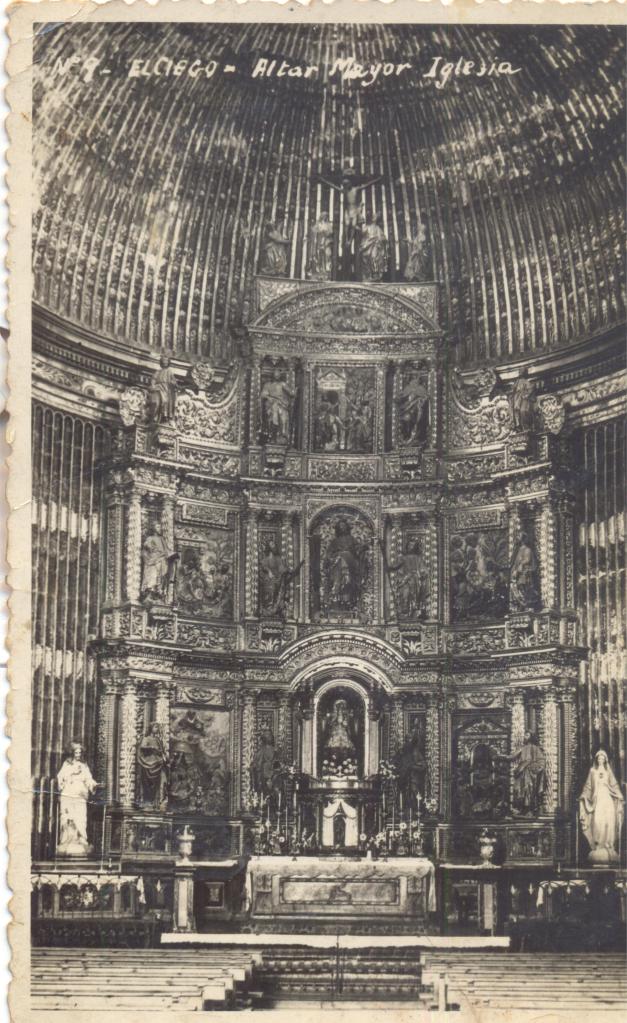
PLAZAKO ANDRA MARIAREN ERMITA (ZIEKO)

Bisitari agurgarria, ongi etorri Plazako Andra Mariari eskainitako ermita honetara. Tenplu hau Erdi Aro Behean eraiki zen, Jainkoaren Amari Ziekoko herritarren debozio handiagatik.

1761ean Ziekoko herritarrak oso kezkatuta zeuden, “Plazako Birjinaren” ermita gotikoa lurreratzeko zorian zegoelako. Bere egoera hondatua zen benetan eta lur-jotze-arrisku argia zegoen. Horregatik erabaki zen Hiribilduko Zaindariaren tailua San Andresen parrokia-elizara mugitzea eta eraikin berria eraikitzea pentsatzea serio.

Birjinari herriko debozioak Ziekoko herritarren bihotzak hunkitu zituen Andra Mariari eskainitako tenplu berri bat eraikitzeko. 1763tik 1765era eraiki zen eta Bernardino Ruiz de Azcárragaren lana da, arkitekto eta hargina. Orain zuk bisitatzen duzuna da.

Ziekoko Plaza Nagusia, egurrezko kioskoa eta Ermita atzealdean .

“Ardoa bere kontsumorako ematen zien mahastiko bere bi, hiru edo lau gizalan hiribilduko populazio apalenak ere ermitako eraikuntzaren zerbitzura jar zezala lortu zuen Mariari maitasun handiak.” (Gizalan: 200 mahasti)

Hegoaldeko fatxadan dagoen atetik sartu eta gero, zure bisita has zaitez. Oinplano oktogonaleko tenplua da, neurri txikikoa, eta zortzi aingeru txikirekin inguratutako medailoian amaitzen dituzten nerbio batzuek zeharkatutako esferaerdi-formako ganga koroatzen du. Hartan, usoa, gure bizitza Argiz betetzen duen Espiritu Santuko sinboloa, ikus daiteke, kupulako paretetan egindako zulo bezala, ermita argitasunez betetzen dutenak. Badirudi multzo osoak jasotzen gaituela.

Zure begirada goitik jaitsi eta tenpluko atzealdera joan. Mendebaldeko horman, aitzinean “Corpus Christi” prozesioan erabilitako kustodia ederra dago. ezkerretara, arkupean, errotze handia duten hiru santuen tailuak daude; Ostiako San Gregorio, Errioxan eta Nafarroan debozio handiko santua; San Bizente, eskuineko eskuan palma duena, martirioaren sinboloa, eta San Anastasio, 628ko urtarrilaren 22an burua moztu zen monje persiarra. San Bizenteren heriotzako data bera da, nahiz eta urte desberdinekoa den. Horregatik, San Bizentek eta San Anastasiok kultua partekatzen dute askotan, batez ere Italian, baina baita euskal lurretan ere.

Datorren arkuterian, San Sebastian eta San Roke tailuek Gurutziltzatu leunari laguntzen diote. San Sebastianen irudikapen ikonografikoa klasikoa da. Santu hau zuhaitz bati lotuta dago, eta geziz sastakatuta du gorputza, hori baita haren martiritzaren sinboloa, Jesukristoren partaide izateagatik.

Bitartean, San Rokek, erromesez jantzita, zangoa zauriturik erakusten du izurrien ondorioz. Txakur bat du alboan: egunero jaten ematen zuen eta bere gaitza Jainkoaren Probidentziaz sendatu izanaren sinboloa. 

Erdi Aroko garaian bi santu hauengatik debozio handia izan zuen herriak izurrien aurkako eta hilzorian zeudenen zaindariak izateagatik. Horregatik, Europa osoko tenplu desberdinetan elkarrekin maiz ikusten da.
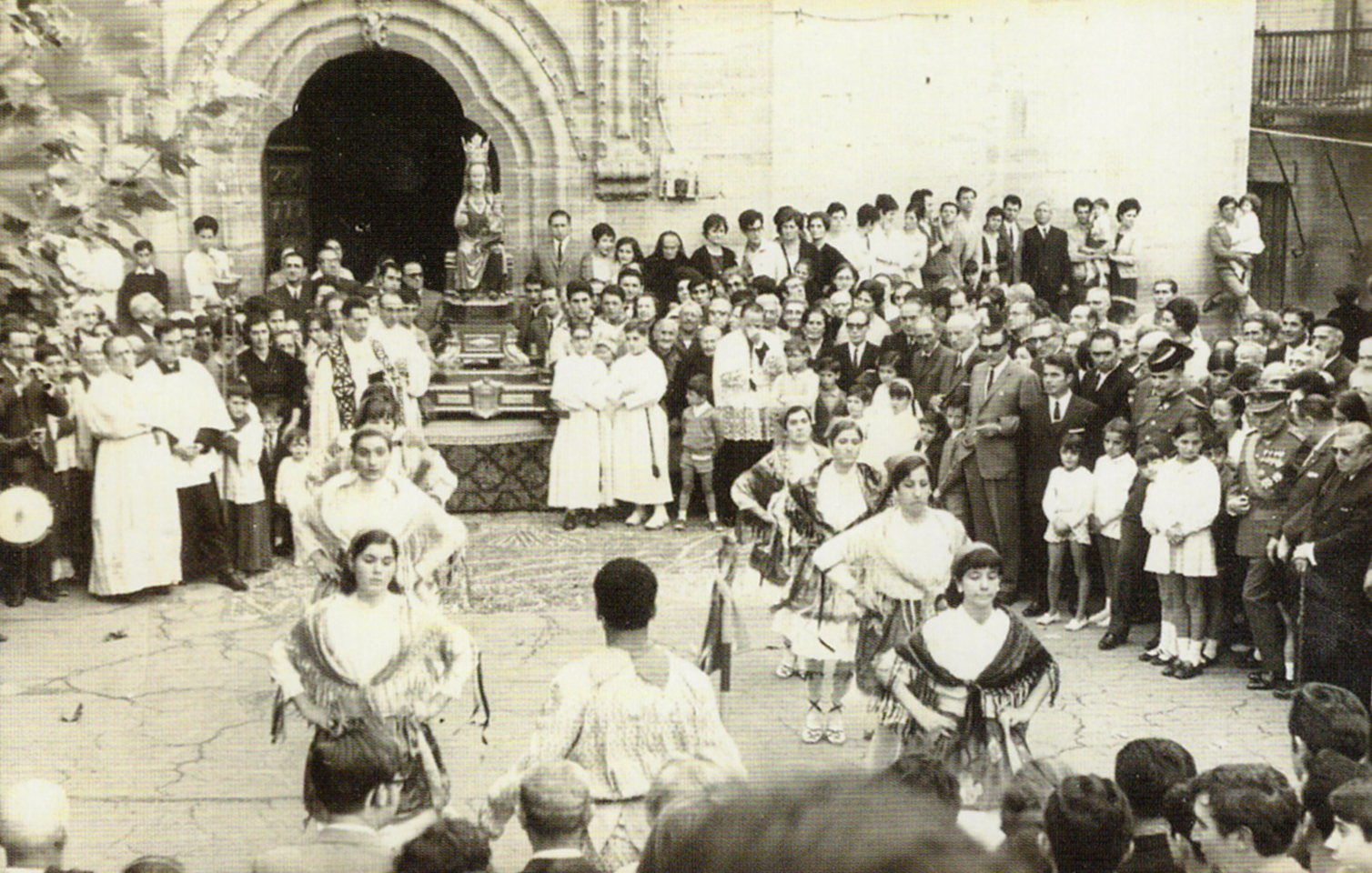
Dantzariak dantzatzen Plaza Nagusian, Plazako Birjinaren aurrean. 1968 .

Orain, lagun maitea, lehenengo ilarako eserlekuan jar zaitezke, absideko erretaulen multzoa adi eta lasai aztertzeko. Ezkerretatik eskuinetara, San Joseren erretaula; Plazako Birjinari, herriko zaindaria, eskainitako erdiko erretaula-baldakinoa; eta azkena, San Antonioren erretaula daude.

Alboko erretauletatik has gaitezen. Ezkerretara San Joseri eskainitako erretaula dago, Mariaren senarra, zeinen tailuak, kalitate artistiko handikoa, Jainko Haurtxoa kulunkatzen baitu. Bitartean, eskuineko erretaulan, Paduako San Antoniok, era berean, Jesus Haurtxoa sostengatzen du. San Gaitanez gain, haien besoetan Haurrarekin irudikatzen zaizkien santu bakarrak direla nabarmendu behar da.

Plazako Birjinaren ermita, hiribilduko bihotzean kokatuta, lurrarekin eta bere mahastiekin, Mariarekiko bere jendeen erlazioaren lekukotasuna da. Bere harriak haien zelaietako erraietatik atera ziren, gure Salbatorea Mariaren sabeletik jaiotzen den bezala.

Erdiko erretaulak, Plazako Birjinari eskainitakoa, Ziekoko zaindaria, ez du zerikusirik albokoekin, egikera eta kalitateari dagokienez. Sebastian de Oyarzabalen, erretaula egile ospetsua, lana da. Oyarzabal barroko klasizistenako ordezkarien bat da eta lau lan bikain egin zituen herrian: erretaula nagusia eta bi albokoak San Andresen parrokia-elizan eta begiesten duzuna. Honek guztiak denbora haietako Ziekoko garrantzia eta botere ekonomikoa azpimarratzen ditu.

Plazako Andra Mariaren tailua aterpetzeko pentsatuta dago erretaula-baldakinoa, eta bi atal desberdinak ondo ikus daitezke.

Goiko atalak, baldakinoa, “Plazako Birjina” erakusteko balio du, Andra Mari ederra gotikoa XIV. mendearen amaieretako. Tailuak bere eskuineko eskuan lore bat du, Haurra sostengatzen du bere beste eskuan berriz. Bereziki Jesus Haurra nabarmentzen da gu bedeinkatzeko jarreran eta mundua bere eskuan eramanez. Bada, sinbolismoaz betetako edertasun handiko eskultura, aspalditik Ziekoko biztanleek neurrigabeko gurtza dutena.

Eskultura-multzo bikainaren beheko aldean, ia oharkabean bezala, ermita honetako altxorrik handiena aurkituko dugu: Jainkoaren Presentzia Eukaristikoa Sagrarioan. Kristo biziak maite zaitu, itxaroten zaitu eta gure alboan da beti.
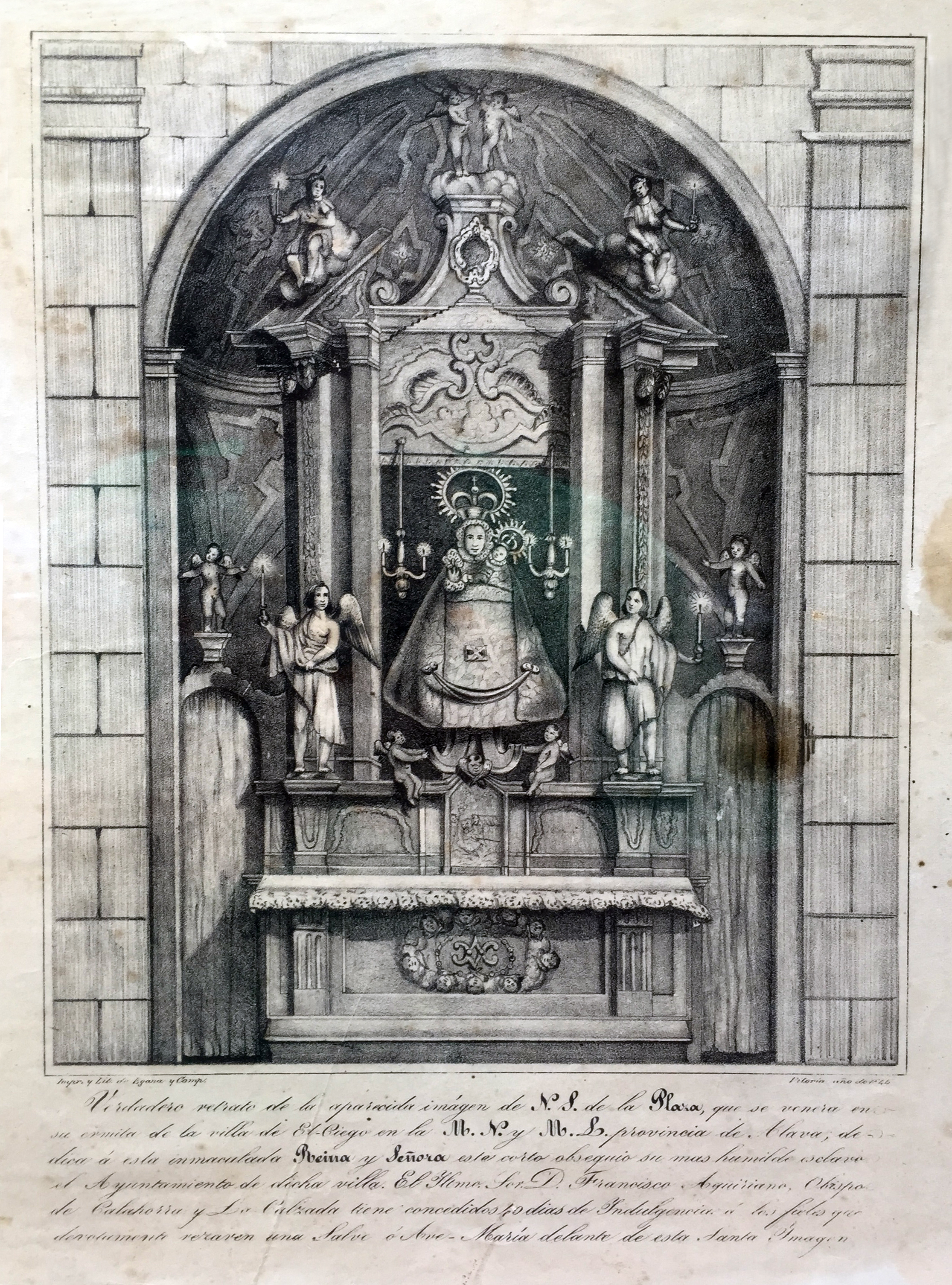
Plazako Birjina.

“Dena grazia da, dena Jainkoaren dohaina da, guganako baldintza gabeko maitasunari esker”

Amaitzera doa Plazako Andra Mariaren ermitako bisita, zeinetan uztartu baititugu artea eta fedea. Bisita atsegina gertatu izana opa dizugu. Santuen bizitzetan sakondu nahi izanez gero, esteka batzuk atxiki dizkiogu testuari. Nolanahi ere, tenplutik irten eta zure bideari jarraitu aurretik, gonbita egin nahi dizugu otoitzerako eta hausnarrerako tartetxo bat har dezazun. Eseri eliza honi izena ematen dion Gure Amaren irudi abegitsuaren aurrean, eta hausnar egin haren bizitza jaierazko eta esker onekoaz. Edo gurtu eta loriatu Jainkoa Sagrarioaren aurrean. Horretarako, eskuragarri dituzu hainbat otoitz, nor bere baitara biltzeko une honetan lagungarri gerta dakizkizukeenak.

EGUNEKO EBANGELIOA / ARROSARIOA / VIA CRUCIS / VIA LUCIS

Hiru egunera, ezteiak izan ziren Galileako Kanan, eta han zen Jesusen ama. Jesus eta beronen ikasleak ere gonbidatu zituzten ezteietara. Eta ardoa amaitu baitzen, esan zion amak Jesusi: –Ez dute ardorik. Jesusek erantzun zion: –Utz nazazu bakean, emakume. Oraino ez da etorri nire ordua. Jesusen amak honela esan zien zerbitzariei: «Egin horrek esango dizuena».


Hiru gauza ditugu oraindanik, iraunkor direnak: sinesmena, itxaropena eta maitasuna. Baina hiruretan handiena MAITASUNA da.
(1 Kor. 13, 13)
 
Asko baduzu; asko.
Gutxi baduzu; gutxi.
Ezer ez baduzu, ezer ez.
 
ERMITATIK IRTETEAN, EGIN ZURE DOHAINTZA

PLAZAKO BIRJINARI HIMNOA
Oh, Virgen de la Plaza, Madre del Salvador,
Nobles hijos de Elciego, con cálido fervor
y fe que los abraza imploran tu favor,
dulce Patrona nuestra, danos tu bendición.
 
Desde los años remotos en tan sagrada mansión,
Padres e hijos muy devotos ante tu imagen bendita,
dejaron página escrita con labios y Corazón.
 
Oh, Virgen de la Plaza, Madre del Salvador,
Nobles hijos de Elciego con cálido fervor.
 
Nosotros agradecidos, con esta antorcha dorada
por esa ruta heredada, iremos siembre hacia Dios.
Segura nuestra mirada y fieles siempre a tu amor.
 
Oh, Virgen de la Plaza, Madre del Salvador,
Nobles hijos de Elciego con cálido fervor.
 
Gracias oh Madre querida, mira estos campos y hogares,
restaña nuestras heridas, alivia nuestros pesares,
pues rendidos a tus pies nos das tu amor a raudales.
 
Oh, Virgen de la Plaza, Madre del Salvador,
Nobles hijos de Elciego con cálido fervor.


AGUR MARIA
Agur Maria graziaz betea,
Jauna da zurekin,
bedeinkatua zera zu andre guztien artean
eta bedeinkatua da zure sabeleko fruitua Jesus.
Santa Maria Jaungoikoaren Ama
erregutu ezazu gu bekatarion alde
orain eta gure heriotzako orduan.
Amen.


SALBE
Agur Erregina, Ama errukiorra
gure bizitza, gozotasun eta itxaropena, agur.
Zuri deiez gatozkizu Ebaren ume erbestetuok.
Antziz eta negarrez gatozkizu negar herri honetan.
Ea bada gure bitarteko andrea.
Zure begi errukitsu horiek gugana jaitsi itzazu
Eta erbeste honen ondoren erakusguzu Jesus,
zure sabeleko seme onetsi hori.
Oh, Bihotz bigun! Oh, Errukior! Oh, Maria, Birjina Gozoa!
Gure alde otoitz egizu Jaungoikoaren Ama done horrek
Jesukristo gure Jaunaren agintaritzak jadetsi ditzagun. Amen.
– – – – –
Salve Regina, Mater misericordiae,
Vita dulcedo et spes nostra salve.
Ad te clamamus exsules filii Hevae.
Ad te suspiramus gementes et flentes,
in hac lacrimarum valle.
Eja ergo advocata nostra,
illos tuos misericordes oculos ad nos converte.
Et Jesum benedictum fructum ventris tui
nobis post hoc exsilium ostende.
O clemens, o pia, o dulcis Virgo Maria.

ERMITA DE NTRA. SRA. DE LA PLAZA (ELCIEGO)

Querido visitante, eres bienvenido a la ermita de Nuestra Señora de la Plaza. Este templo fue levantado en la Baja Edad Media dada la gran veneración del pueblo de Elciego a la Madre de Dios.

Corría el año de 1761 y los vecinos de Elciego veían con preocupación cómo la ermita gótica de la “Virgen de la Plaza” amenazaba ruina. Su estado era verdaderamente ruinoso y existía un claro peligro de derrumbe, por lo que se determinó que la imagen de la Patrona de la Villa se trasladase a la iglesia parroquial de San Andrés y que se planteara seriamente la construcción de una nueva edificación.

La devoción popular a la Virgen movió los corazones de los habitantes de Elciego para erigir un nuevo templo a Santa María que se levantó entre los años 1763 al 1765, obra del arquitecto y cantero Bernardino Ruiz de Azcárraga. Es el que ahora tú estás visitando.

Plaza Mayor de Elciego con el quiosco de madera y la Ermita al fondo.

“El gran amor a María hizo que hasta la población más humilde de la villa, puso al servicio de la construcción de la ermita sus dos, tres o cuatro obradas de viña que les proporcionaba vino para su consumo.” (Obrada: 200 cepas)

Después de acceder por la portada situada en la fachada sur, comencemos nuestra visita. Puedes advertir que se trata de un templo de planta octogonal, de pequeñas dimensiones, siendo rematado por una bóveda semiesférica que es atravesada por un conjunto de nervios que confluyen en un medallón enmarcado por ocho pequeños ángeles, en el que podemos distinguir una paloma, símbolo del Espíritu Santo que llena nuestra vida de Luz, al igual que los óculos horadados en los paños de la cúpula, que llenan de luminosidad la ermita. Parece que todo el conjunto nos envuelve.

Bajamos nuestra mirada de las alturas por un rato, y nos dirigimos a la parte posterior del recinto. En el muro oeste está situada una bella custodia, utilizada en tiempos pasados en la procesión del “Corpus Christi”. A su izquierda, bajo los arcos, se encuentran las tallas de tres santos con gran arraigo; San Gregorio Ostiense, santo con gran devoción en las tierras de La Rioja y Navarra; San Vicente, que porta en su diestra la palma, símbolo de su martirio y San Anastasio, monje persa que fue decapitado el 22 de enero del año 628. Es la misma fecha, aunque de distinto año, de la muerte de San Vicente. Por ello, San Vicente y San Anastasio comparten en muchas ocasiones su culto, sobre todo en Italia, pero también en nuestras tierras.

En la siguiente arquería, un delicado Crucificado es acompañado por las efigies de San Sebastián y San Roque. La representación iconográfica de San Sebastián es la clásica. Este santo está atado a un árbol y con el cuerpo saetado, martirizado como causa de su conversión y seguimiento a Jesucristo.

Por su parte, San Roque muestra las llagas de su pierna originadas por la peste y está acompañado por un perro, siempre incluido en la iconografía del santo, que le alimentaba diariamente y es signo de la providencia divina.  

Ambos santos gozaron de una gran devoción en épocas medievales siendo patronos de los moribundos y protectores frente a la peste. Por ello es habitual que aparezcan juntos en innumerables templos de toda Europa.

Dantzaris bailando en la Plaza Mayor, frente a la Virgen de la Plaza. 1968.

Ahora, querido amigo, te invitamos a tomar asiento en los bancos delanteros para poder admirar con tranquilidad y detenimiento el conjunto de retablos. De izquierda a derecha, aparecen el retablo de San José, el retablo-baldaquino central consagrado en honor de la Virgen de la Plaza, patrona de la Villa, y el último, el retablo de San Antonio.

Comencemos por los laterales. A la izquierda está dispuesto el retablo dedicado a San José, esposo de María, cuya talla, de gran calidad artística, parece mecer entre sus brazos al Niño Dios, mientras que en el retablo  derecho, de igual modo, San Antonio de Padua sostiene al Niño Jesús. Un dato a reseñar es que, junto a San Cayetano, son los únicos santos a los que se les representa con el Niño en sus brazos.

La ermita de la Virgen de la Plaza, ubicada en el corazón de la Villa es testimonio de la relación de sus gentes con María, con la tierra y sus viñedos. Sus piedras fueron extraídas de las entrañas de sus campos al igual que del vientre de María nace nuestro Salvador.

El retablo central, consagrado a la Virgen de la Plaza, patrona de Elciego, poco tiene que ver en cuanto a su factura y calidad con los laterales. Es obra del insigne retablista Sebastián de Oyarzábal. Oyarzábal es uno de los representantes del barroco más clasicista, que dejó en la Villa cuatro magníficas obras: el retablo mayor y los dos colaterales en la iglesia parroquial de San Andrés y éste que estamos contemplando. Todo esto remarca la relevancia y el potencial económico de Elciego en aquellos tiempos.

El retablo-baldaquino se concibe para albergar la talla de Nuestra Señora de la Plaza, pudiéndose distinguir dos partes bien diferenciadas.

El cuerpo superior, que es el baldaquino propiamente dicho, sirve como expositor a la “Virgen de la Plaza”, preciosa Andra Mari gótica de finales del siglo XIV. La talla porta una flor en su mano derecha, mientras que sostiene al Niño en su otra mano. Destaca especialmente el Niño Jesús en actitud de bendecirnos portando el mundo en su mano. Es una imagen de gran belleza, cargada de simbolismo, a la que las gentes de Elciego conceden una inmensa veneración desde tiempos inmemoriales.

En la parte inferior de este magnífico conjunto escultórico, está ubicado el tabernáculo, donde parece pasar desapercibido el más grande tesoro que podemos encontrar en este templo, la Presencia Eucarística de Cristo en el Sagrario. Cristo Vivo que te ama, te espera y que hace nuevas todas las cosas.

Virgen de la Plaza.

“Todo es gracia, todo es don gratuito de Dios y de su amor incondicional por nosotros.”

Vamos acabando nuestra visita a la Ermita de la Plaza donde hemos aunado arte y fe. Deseamos que tu visita haya sido grata, pero antes de abandonar la ermita para seguir tu camino, te invitamos a tener un rato de recogimiento y oración, a sentarte en silencio ante la acogedora presencia de Nuestra Madre, la Virgen María, meditando su vida de entrega y gratitud. O simplemente, a alabar y dar Gloria al Señor frente al Sagrario. Para ello, ponemos a tu disposición algunas oraciones que pueden ser útiles y diversos enlaces para profundizar en la vida de los Santos.

EVANGELIO DIARIO / ROSARIO / VIA CRUCIS / VIA LUCIS

Se celebró una boda en Caná de Galilea y estaba allí la madre de Jesús. Fueron invitados también a la boda Jesús y sus discípulos. Y faltando el vino, la madre de Jesús le dijo: “No tienen vino”. Jesús le respondió: “¿Qué nos va a ti y a mí, mujer? Mi hora aún no ha llegado”. La madre dijo a los sirvientes: “Haced lo que él os diga”.


Ahora permanecen estas tres cosas; la fe, la esperanza y la caridad. Pero la más excelente de ellas es la CARIDAD.
(1 Cor. 13, 13)
 
Si puedes mucho; mucho.
Si puedes poco; poco.
Si no puedes nada; nada.
 
CUANDO SALGAS DE LA ERMITA, HAZ TU DONATIVO

HIMNO A LA VIRGEN DE LA PLAZA
Oh, Virgen de la Plaza, Madre del Salvador,
Nobles hijos de Elciego, con cálido fervor
y fe que los abraza imploran tu favor,
dulce Patrona nuestra, danos tu bendición.
 
Desde los años remotos en tan sagrada mansión,
Padres e hijos muy devotos ante tu imagen bendita,
dejaron página escrita con labios y Corazón.
 
Oh, Virgen de la Plaza, Madre del Salvador,
Nobles hijos de Elciego con cálido fervor.
 
Nosotros agradecidos, con esta antorcha dorada
por esa ruta heredada, iremos siembre hacia Dios.
Segura nuestra mirada y fieles siempre a tu amor.
 
Oh, Virgen de la Plaza, Madre del Salvador,
Nobles hijos de Elciego con cálido fervor.
 
Gracias oh Madre querida, mira estos campos y hogares,
restaña nuestras heridas, alivia nuestros pesares,
pues rendidos a tus pies nos das tu amor a raudales.
 
Oh, Virgen de la Plaza, Madre del Salvador,
Nobles hijos de Elciego con cálido fervor.


ACORDAOS
Acordaos, ¡oh piadosísima Virgen María!
que jamás se ha oído decir que ninguno de los que han acudido a vuestra protección,
implorado vuestra asistencia y reclamando vuestro socorro, haya sido abandonado de Vos.
Animado con esta confianza, a Vos también acudo, ¡oh Madre, Virgen de las vírgenes!
Y aunque gimiendo bajo el peso de mis pecados,
me atrevo a comparecer ante vuestra presencia soberana.
No desechéis, ¡oh Madre de Dios!, mis humildes súplicas,
antes bien, inclinad a ellas vuestros oídos y dignaos atenderlas favorablemente.


LA SALVE
Dios te salve, Reina y Madre de misericordia,
vida, dulzura y esperanza nuestra; Dios te salve.
A Ti clamamos los desterrados hijos de Eva;
a Ti suspiramos, gimiendo y llorando, en este valle de lágrimas.
Ea, pues, Señora, abogada nuestra,
vuelve a nosotros esos tus ojos misericordiosos,
y después de este destierro muéstranos a Jesús,
fruto bendito de tu vientre.
¡Oh clemente, oh piadosa,
oh dulce Virgen María!
Ruega por nosotros Santa Madre de Dios.
Para que seamos dignos de alcanzar las promesas de nuestro Señor Jesucristo. Amén.
– – – – –  
Salve Regina, Mater misericordiae,
Vita dulcedo et spes nostra salve.
Ad te clamamus exsules filii Hevae.
Ad te suspiramus gementes et flentes,
in hac lacrimarum valle.
Eja ergo advocata nostra,
illos tuos misericordes oculos ad nos converte.
Et Jesum benedictum fructum ventris tui
nobis post hoc exsilium ostende.
O clemens, o pia, o dulcis Virgo Maria.

ÉGLISE DE SAINT ANDRÉ (ELCIEGO)

Cher visiteur, vous êtes bienvenu au village d’Elciego et à son église de Saint André. Ce temple a été visité au cours des siècles pour trouver des moments de recueillement et de prière par les paroissiens, les voyageurs et les marchands qui passaient par Elciego.

La construction de ce temple a commencé au milieu du XVIe siècle, probablement sur un ermitage précédent. En raison de sa situation, il était nécessaire de construire une grande plate-forme pour niveler le terrain. Comme vous avez pu le constater avant d’entrer dans le temple, l’église de Saint André se distingue par ses tours remarquables et inégales qui sont l’image emblématique de la ville. Il a une grande unité extérieure qui manifeste son homogénéité esthétique, mais non chronologique, car il réunit différents styles architecturaux. Les premières sections sont gothiques, alors que la croisière est clairement Renaissance. Son plan est de croix latine et se compose d’une nef de trois sections, croisière et tête, résultant en un ensemble de proportions harmonieuses.

Vue panoramique d’Elciego avec l’église de Saint André. 1950 .

Commençons notre visite. En entrant dans le temple, vous avez trouvé un Christ crucifié d’une grande dévotion parmi le peuple d’Elciego. Nous sommes au bas du chœur. Élevez votre regard pour découvrir la voûte d’ogives, joliment décorée de fleurons dans ses clés, qui soutient la structure du chœur. Au centre, nous pouvons voir l’image de Dieu le Père Créateur; et autour de lui, il y a différents reliefs. Parmi eux se distinguent les quatre évangélistes, Saint André, saint patron de l’église avec sa croix caractéristique, et Saint Pierre avec les clés du Royaume.

Baissez les yeux et allez vers le côté opposé, où se trouve le baptistère. Après une grille sobre et élaborée avec une inscription biblique se trouvent les fonts baptismaux. Le Baptême est le fondement de la vie chrétienne, c’est le portique de la vie dans l’Esprit et la porte qui ouvre l’accès aux autres sacrements. Par le Baptême, nous sommes libérés du péché et régénérés en tant qu’enfants de Dieu, devenant membres du Christ et intégrés à l’Église.

«En vérité, en vérité, je te le dis, si un homme ne naît d`eau et d`Esprit, il ne peut entrer dans le royaume de Dieu» Jean 3, 5

À la droite du baptistère, il y a plusieurs reliques des Martyrs de Cardeña. Lors de l’invasion arabe à la fin du IXe siècle, 200 moines ont été massacrés par les armées musulmanes. Ils ont été canonisés en 1603.

Maintenant, à travers le couloir central, vous arrivez au sommet de l’église et vous pourrez admirer les divers retables qui occupent les murs latéraux. Si vous pensez que cela est nécessaire, allez à ces retables pour les voir en détail.

Le premier retable que nous trouvons à notre droite est dédié à Sainte Anne, mère de la Vierge. Le corps principal est constitué de colonnes à cannelures divisant trois espaces. L’image du titulaire occupe l’espace central, tandis que sur les côtés, on distingue les statues de Saint Laurent avec la grille, symbole de son martyre, et Saint Roch qui montre les plaies sur sa jambe et est accompagné d’un chien qui l’aidera à ses moments les plus nécessiteux, un signe de providence et toujours inclus dans l’iconographie du saint. L’ensemble est surmonté d’un tableau représentant les Âmes Bénies du Purgatoire.

À votre gauche, sous le magnifique orgue de la paroisse, se trouve le retable de l’Archevêque. Il a été nommé ainsi, car il a été payé par le fils distingué de la ville, Monsieur Manuel Francisco Navarrete et Ladrón de Guevara, Archevêque de Burgos et évêque de Mondoñedo-Lugo. Le groupe est composé de deux toiles qui reproduisent la prison et le martyre des saints Manuel, Sabellio et Ismael, et sont flanquées des sculptures des martyrs, Sainte Catherine d’Alexandrie et Sainte Lucie, protectrice de la vue.

Rue Concepcion avec l’église de Saint André en arrière-plan.

À côté, se trouve le retable rococo consacré à Saint Joseph, dont l’image est accompagnée des sculptures du grand prédicateur dominicain Saint Vincent Ferrier et Saint Raymond Nonnat, protecteur des femmes enceintes. Dans la partie supérieure se trouve l’effigie de Saint Grégoire Ostiense, un saint dévoué de La Rioja et de Navarre, dont les reliques sont vénérées dans la Basilique de Sorlada, dans la Navarre voisine.

Sur le mur de droite, devant le retable que vous avez observé, se trouve un autre retable rococo. Il est dédié à la Vierge des Douleurs, dont l’image occupe la niche centrale accompagnée des sculptures de Saint Isidore et de Marie de Magdala. Dans la partie supérieure, la taille de Saint Jean le Baptiste couronne l’ensemble. Dans la partie inférieure se trouve la figure connue sous le nom de «tumbao». C’est un Christ couché, une sculpture magnifique et aux bras articulés, qui, avec la sculpture de la Vierge des Douleurs, fait partie de la représentation de la «Descente» lors de la Semaine Sainte de la ville.

Vous arrivez à la croisière du temple. Deux imposantes chaires apparaissent devant vous. Bien qu’ils aient été construits à quarante ans d’intervalle, ils se ressemblent. Les deux ont été fabriqués au XVIIIe siècle et possèdent un balcon avec des balustres forgés recouverts de plaques dorées et un haut abat-son.

Avant de regarder attentivement le retable principal, nous vous suggérons de vous approcher des retables du transept, contemporains du principal et identiques dans leur conception. Le retable de droite est dédié au Saint Christ, image de grande qualité. Au bas, on remarque les reliefs de «la flagellation» et «le couronnement d’épines», tandis qu’une sculpture de Saint François Xavier complète l’ensemble.

Sur la gauche, à l’opposé, se trouve le retable de Notre Dame du Rosaire, dont la niche centrale est occupée par une réplique de la Vierge d’Estibaliz, sainte patronne d’Álava. Le grenier est occupé par l’effigie de Saint Sébastien, un martyr avec une grande dévotion dans le passé, parce que c’est le saint patron des mourants et le protecteur contre la peste. Après avoir découvert des thèmes et des personnages inconnus lors de votre transit à travers le temple, c’est le moment de contempler l’extraordinaire retable principal dédié à Saint André, titulaire de l’église. Pour l’admirer en détail et approfondir sa beauté, nous vous invitons à prendre place sur les banquettes avant.

Intérieur de l’église. Fin des années 50.

Probablement, en entrant dans le temple, votre regard a été dirigé avec curiosité sur la tête du temple. C’est une abside semi-circulaire construite entièrement en pierre dorée, entièrement cannelée, qui prolonge son décor de la coquille supérieure au sol, produisant un effet de coquille enveloppante autour du retable. Tout cela crée un ensemble frappant et incomparable.

Ce retable majestueux date du début de l’époque baroque, bien qu’il ait d’importantes influences de la Renaissance. Il a été érigé entre les années 1646 et 1669. Le retable se compose d’un banc, de trois corps et d’un grenier, divisé en trois rues et quatre petites rues.

Commençons par le bas appelé la banque. Vous pouvez y distinguer, parmi les figures de divers saints, les reliefs correspondant à la «Capture de Notre Seigneur» et à «la Chute de Jésus sous la Croix». Un beau tabernacle qui occupe le cœur du bas est orné de la figure du Christ Sauveur, flanquée de celles de Saint Pierre et Saint Paul. Ce sont peut-être des reliefs plus délicats du tout.

Dans le premier corps, l’image de Notre Dame du Rosaire occupe le tabernacle central. À gauche, le relief de «L’Annonciation», entre les sculptures de Saint Jean et de Saint Pierre. Pendant ce temps, à droite, entre les effigies de Saint Paul et de Saint Jacques le Apôtre, on peut voir le relief de «La Nativité».

De gauche à droite, dans le second corps, vous pouvez voir les reliefs dédiés à «l’Adoration des mages» et «La fuite en Egypte», parmi les sculptures de Saint Jacques d’Alphée, Saint Thomas, Saint Philippe et Saint Barthélemy, tandis que la figure de Saint André, plus grande et avec sa croix classique en X, symbole de son martyre, occupe la niche centrale et préside le retable.Saint André a eu le privilège d’être le premier apôtre choisi par Jésus. Pour cette raison, il a toujours été appelé Πρωτόκλητος Prōtoklētos, «le premier appel».

André, frère de Simon Pierre, était l`un des deux qui avaient entendu les paroles de Jean, et qui avaient suivi Jésus. Ce fut lui qui rencontra le premier son frère Simon, et il lui dit: Nous avons trouvé le Messie (ce qui signifie Christ). Et il le conduisit vers Jésus. Jésus, l`ayant regardé, dit: Tu es Simon, fils de Jonas; tu seras appelé Céphas (ce qui signifie Pierre) Jean 1, 40-42

Dans le troisième et dernier corps, le relief dédié à «La Visitation de la Vierge Marie à sa cousine Sainte Élisabeth» est escorté par les gravures de Saint Matthieu et Saint Simon, à gauche, et celles de Saint Matthias, l’apôtre qui a remplacé à Judas, et une sculpture anonyme, à droite.

Le grenier est surmonté d’un fronton incurvé et dans le tympan se trouve la figure du Père Éternel avec une sphère à la main. Au-dessus de lui, en couronnant cet impressionnant retable, on peut voir la représentation du «Calvaire»: le Christ crucifié accompagné de Marie, sa mère; Saint Jean, le disciple bien-aimé; Marie de Magdala et Marie de Clopas. C’est une composition iconographique atypique avec cinq figures, incorporée après tout.

“Près de la croix de Jésus se tenaient sa mère et la sœur de sa mère, Marie, femme de Clopas, et Marie de Magdala. Jésus, voyant sa mère, et auprès d`elle le disciple qu`il aimait, dit à sa mère: Femme, voilà ton fils. Puis il dit au disciple: Voilà ta mère. Et, dès ce moment, le disciple la prit chez lui.” Jean 19, 25-27

Autel et retable principal.

Et dans la partie inférieure de ce retable extraordinaire, le plus grand trésor que nous puissions trouver dans ce temple, la Présence Eucharistique du Seigneur dans le Tabernacle, passe inaperçu. Le Christ vivant nous a sauvés et rachetés, nous a librement donné la vie éternelle et est toujours à nos côtés.

“Notre salut est un don du sang de Christ, tout est un don gratuit de Dieu et de son amour pour nous”

Nous espérons que votre visite a été agréable. Avant de quitter le temple en suivant votre chemin, nous vous invitons à prendre un moment de recueillement et de prière, à vous asseoir en silence devant la présence accueillante de Notre Mère, en méditant sa vie de dédicace et de gratitude, ou tout simplement à louer et à glorifier le Seigneur en sa présence devant le Tabernacle.

(Nous mettons à votre disposition des prières et des liens qui pourraient vous aider en ces moments d’intériorisation. De la même façon, vous pouvez mieux connaître la vie des saints qui composent le retable grâce aux différents liens figurant dans le texte.)

EVANGILE DU JOUR / ROSAIRE / VIA CRUCIS / VIA LUCIS


Maintenant donc ces trois choses demeurent: la foi, l`espérance, la charité; mais la plus grande de ces choses, c`est la CHARITÉ.
(1 Cor. 13, 13)
 
Si vous pouvez beaucoup ; beaucoup.
Si vous pouvez peu; un peu.
Si vous ne pouvez rien faire; rien.
 
QUAND VOUS QUITTEZ L’ÉGLISE, FAISEZ VOTRE DON

PRIERE A SAINT ANDRE
Saint André, Apôtre de Jésus-Christ,
qui as connu l’exigence et la joie de son premier appel,
donne-nous la grâce de Lui répondre
avec la même fidélité,
de Le servir chaque jour
dans le lieu que lui-même a choisi pour nous.
Toi qui as distribué à la foule affamée
le pain que le Seigneur multipliait entre tes mains,
obtiens pour notre pauvreté le même miracle.
Fais que nous attendions le secours de Dieu
avec l’inébranlable espérance de l’amour,
soucieux uniquement de l’avènement de ton Règne.
Témoin de la bonne-nouvelle
que ta voix a portée jusqu’aux extrémités de la terre,
conserve chez les apôtres de notre temps,
cette foi vive qui transporte les montagnes
et construit le Royaume.
Martyr de ton témoignage,
accorde-nous la grâce
de l’union à la croix de Jésus-Christ;
qu’elle soit la joie de notre vie
et le gage de notre résurrection dans la clarté de Dieu.
Amen!


APPEL AU SAINT ESPRIT
O Saint Esprit,
que ton Amour immense éveille
tous les cœurs meurtris par la douleur!
 
O Saint Esprit,
que par ta volonté, les affamés de par le monde entier 
retrouvent le chemin de leur nourriture
et qu’enfin ils puissent se rassasier de la vraie vie
qui est celle que tu nous promets à tous…
 
O Saint Esprit,
que par ta grâce, les dirigeants du monde
soient un peu indulgents envers leur peuple pour qu’enfin
disparaissent les haines et disputes entre les hommes,
C’est avec toi que nous arriverons à Dieu le Père tout puissant!
 
O Saint Esprit,
que par cette courte prière pense à tous ceux
qui espèrent en toi,
aide chacun à pouvoir accepter ta volonté, 
et donne à chacun la force de pouvoir valider ta volonté!
Amen.

SAINT ANDREW’S CHURCH (ELCIEGO)

Dear visitor, you are welcome to the village of Elciego and its church of Saint Andrew. This temple has been visited over the centuries to find moments of recollection and prayer, by its parishioners, by travellers and merchants who passed through Elciego.

The construction of this temple began in the mid-sixteenth century, probably over a previous hermitage. Due to its situation, it was necessary to build a large platform to level the terrain. As you saw before entering the temple, the church of Saint Andrew stands out for its outstanding and unequal towers that are the emblematic image of the town. It enjoys a great exterior unity that manifests its aesthetic homogeneity, but not chronological, because it brings together different architectural styles. The first sections are Gothic, while the crossing is clearly Renaissance. The temple has a Latin cross plan and a nave with three sections, transept and headboard, and becomes a set of harmonious proportions.

Panoramic view of Elciego with the church of Saint Andrew. 50’s .

Let’s start our visit. Upon entering the temple you have found a crucified Christ of great devotion among the people of Elciego. We are at the bottom of the choir. Elevate your gaze to discover the ribbed vault, decorated beautifully with fleurons in its keys, which supports the framework of the choir. In the centre we can see the image of God the Father, Creator; and around it, there are different reliefs. Among them, stand out the four evangelists, Saint Andrew, patron saint of the church with its characteristic cross, and Saint Peter with the keys of the Kingdom.

Lower your gaze and go to the opposite side, where the baptistery is located. After a sober and elaborate grille with a biblical inscription the baptismal font is located. Baptism is the foundation of the Christian life; it is the portico of life in the Spirit and the door that gives access to the other sacraments. Through Baptism we are freed from sin and regenerated as children of God, becoming members of Christ and incorporated into the Church.

«I tell you for certain that before you can get into God’s kingdom, you must be born not only by water, but by the Spirit» John 3, 5

To the right of the baptistery, there are several relics of the Martyrs of Cardeña. During the Arab invasion at the end of the 9th century, 200 monks were slaughtered by the Muslim armies. They were canonized in the year 1603.

Now, through the central corridor, you arrive at the head of the church and you can admire the various altarpieces that occupy the side walls. If you think it is necessary, go to these altarpieces to see them in detail.

The first altarpiece that you find on your right is dedicated to Saint Anne, mother of the Virgin. The main body has fluted columns that divide it into three spaces. The image of the owner occupies the central space, while on the sides you can distinguish the statures of Saint Lawrence with the grill, symbol of his martyrdom, and Saint Roch that shows the sores on his leg and is accompanied by a dog that helped him during the moments of greatest need, a sign of providence and always included in the iconography of the saint. The set is topped by a painting of the Blessed Souls of Purgatory.

On your left, under the magnificent parish organ is the altarpiece of the Archbishop. It was named so, because it was paid for by the distinguished son of the town, Mr. Manuel Francisco Navarrete and Ladrón de Guevara, Archbishop of Burgos and Bishop of Mondoñedo-Lugo. The group is composed of two canvases that reproduce the prison and martyrdom of the saints Manuel, Sabellio and Ismael, and are flanked by the carvings of the also martyrs, Saint Catherine of Alexandria and Saint Lucy, protector of sight.

Concepcion Street with the church of Saint Andrew in the background.

Beside it, there is the Rococo altarpiece consecrated to Saint Joseph, whose image is escorted by the carvings of the great Dominican preacher, Saint Vincent Ferrer and Saint Raymond Nonnatus, patron saint of pregnant women. In the upper part is the effigy of Saint Gregory Ostiense, a saint with great devotion in La Rioja and Navarre, and whose relics are venerated in the Basilica of Sorlada, in nearby Navarre.

On the right wall, in front of the altarpiece that you have just observed, there is another Rococo altarpiece. It is dedicated to the Virgin of the Sorrows, whose image occupies the central niche being accompanied by the carvings of Saint Isidore and Mary Magdalene. In the upper part, the size of Saint John the Baptist crowns the whole. In the lower part, there is the figure popularly known as the «tumbao». It is a recumbent Christ, a magnificent carving with articulated arms, which, along with the carving of the Virgin of the Sorrows, is part of the representation of the «Descent» in the Holy Week of the town.

You arrive at the crossing of the temple. Two imposing pulpits appear before you. Although they were built forty years apart, they are similar. Both were made in the eighteenth century and have a balcony with forged balusters covered by golden plates and a high canopy.

Before contemplating the main altarpiece carefully, we suggest you approach the altarpieces of the transept, contemporaries with the main and identical in their conception. The altarpiece on the right is dedicated to the Holy Christ, an image of great quality. In the lower part, we notice the reliefs of «the flagellation» and «the crowning of thorns», while a carving of Saint Francis Xavier completes the set.

On the left, on the opposite side, is the altarpiece of Our Lady of Rosary, whose central niche is occupied by a copy of the Virgin of Estíbaliz, patron saint of Álava. The attic is occupied by the sculpture of Saint Sebastian, a martyr with great devotion in the past, because he is the patron saint of the dying and protector against the plague. After having discovered unknown themes and figures in your tour through the temple, it is time to contemplate the extraordinary main altarpiece dedicated to Saint Andrew, owner of the church. To admire it in detail and deepen its beauty, we invite you to take a seat on the front benches.

Interior of the church. End of the 50’s.

Probably, upon entering the temple, your gaze has been directed with curiosity to the head of the temple. It is a semicircular apse built entirely of gilded stone, fully fluted, which extends its decoration from the upper shell to the ground, producing an enveloping shell effect around the altarpiece. All this creates a striking and incomparable set.

This majestic altarpiece is from the early Baroque era, although it has important Renaissance influences. It was erected between the years 1646 and 1669. The altarpiece consists of a bench, three bodies and an attic, dividing into three streets and four small streets.

Let’s start at the bottom called bench. In it you can distinguish, among figures of various saints, the reliefs corresponding to the «Capture of Our Lord» and «the Fall of Jesus under the Cross». A beautiful tabernacle that occupies the heart of the bench, is adorned by the figure of Christ the Saviour flanked by those of Saint Peter and Saint Paul. They are, perhaps, the reliefs made more delicately of the whole.

In the first body, the image of Our Lady of the Rosary occupies the central tabernacle. On the left, there is the relief of «The Annunciation», between the carvings of Saint John and Saint Peter. Meanwhile, on the right, between the effigies of Saint Paul and Saint James Apostle we can see the relief of «The Nativity».

From left to right, in the second body, you can see the reliefs dedicated to «the Adoration of the Magi» and «the flight to Egypt», among the carvings of Saint James the Less, Saint Thomas, Saint Philip and Saint Bartholomew, while the figure of Saint Andrew, larger and with its classic cross in X, symbol of his martyrdom, occupies the central niche, presiding the altarpiece.Saint Andrew had the privilege of being the first apostle chosen by Jesus. For this reason, since ancient times it was called Πρωτόκλητος Prōtoklētos, «the first called».

One of the two men who had heard John and had gone with Jesus was Andrew, the brother of Simon Peter. The first thing Andrew did was to find his brother and tell him, “We have found the Messiah!” The Hebrew word “Messiah” means the same as the Greek word “Christ.” Andrew brought his brother to Jesus. And when Jesus saw him, he said, “Simon son of John, you will be called Cephas.” This name can be translated as «Peter» John 1, 40-42

In the third and last part, the relief dedicated to «the Visitation of the Virgin Mary to her cousin Saint Elizabeth» is escorted by the carvings of Saint Mathew and Saint Simon, on the left, and by the sculptures of Saint Matthias, the apostle who replaced to Judas, and by an anonymous carving, to the right.

The attic is topped by a curved pediment, in whose tympanum is the figure of the Eternal Father with a sphere in his hands. Above him, crowning this impressive altarpiece, we can see the representation of «Calvary»: Christ crucified accompanied by Mary, his mother; Saint John, the beloved disciple; Mary Magdalene and Mary of Clopas. It is an atypical iconographic composition with five figures, incorporated after the whole.

“Jesus’ mother stood beside his cross with her sister and Mary the wife of Clopas. Mary Magdalene was standing there too. When Jesus saw his mother and his favorite disciple with her, he said to his mother, “This man is now your son.” Then he said to the disciple, “She is now your mother.” From then on, that disciple took her into his own home.” John 19, 25-27

Main altar and altarpiece.

And in the lower part of this extraordinary altarpiece, the greatest treasure we can find in this temple, the Eucharistic Presence of the Lord in the Tabernacle, goes unnoticed. The living Christ has saved and redeemed us, has freely given us eternal life and is always at our side.

“Our salvation is a gift of the blood of Christ; everything is a free gift from God and his love for us”

We hope your visit was pleasant. Before leaving the temple following your path, we invite you to have a moment of recollection and prayer, to sit in silence before the welcoming presence of Our Mother, meditating on her life of dedication and gratitude, or simply praise and glorify the Lord in his presence in front of the Tabernacle.

(We put at your disposal some prayers and links that may help you in these moments of internalization. In the same way, you can learn more about the life of the Saints in the altarpiece thanks to the various links in the text.)

GOSPEL OF THE DAY / ROSARY / VIA CRUCIS / VIA LUCIS


For now there are faith, hope, and love. But of these three, the greatest is LOVE.
(1 Cor. 13, 13)
 
If you can much; much.
If you can little; a little bit.
If you can’t do anything; nothing.
 
WHEN YOU LEAVE THE CHURCH, MAKE YOUR DONATION

ST ANDREW’S PRAYER
O Glorious St. Andrew,
you were the first to recognize and follow the Son of God.
With your friend, St. John,
you remained with Jesus,
for your entire life,
and now throughout eternity.
Just as you led your brother, St Peter,
to Christ and many others after him,
draw us also to Him.
Teach us how to lead them,
solely out of love for Jesus
and dedication to His service.
Help us to learn the lesson of the Cross
and carry our daily crosses without complaint,
so that they may carry us to God the Almighty Father. Amen.
 
– – – – –
 
Brother of Simon Peter, you heard John the Baptist say: “Behold the Lamb of God,” and you chose to follow Jesus.
Leaving your nets, you became a successful fisher of souls.
Lover of the Crucified Christ, you too were crucified like him.
Teach us to live and suffer for Him and to win many souls for Christ. Amen.


PRAYER TO THE HOLY SPIRIT
Holy Spirit of light and love,
you are the substantial love of the Father and the Son;
hear my prayer.
Bounteous bestowed of most precious gifts,
grant me a strong and living faith
which makes me accept all revealed truths
and shape my conduct in accord with them.
Give me a most confident hope in all divine promises
which prompts me to abandon myself unreservedly to you and your guidance.
Infuse into me a love of perfect goodwill,
and act according to God’s least desires.
Make me love not only my friends but my enemies as well,
in imitation of Jesus Christ who through you offered himself on the Cross for all people.
Holy Spirit, animate, inspire, and guide me, and help me
to be always a true follower of you.
Amen.

SAN ANDRES ELIZA (ZIEKO)

Bisitari agurgarria, ongi etorri Ziekoko hiribildura eta San Andres eliza honetara. Tenplu honek eliztar ugari hartu ditu mendez mende; izan ere, norbere baitan biltzeko eta otoitz egiteko uneen bila etorri izan dira, baita Ziekotik pasatu diren bidaiari eta merkatari ugari ere.

XVI. mendearen erdian hasi zen tenplu honen eraikuntza, segur aski aurreko ermita gainean. Kokapena dela eta, plataforma handia eraikitzea beharrezkoa zen lurra berdintzeko. Ikus dezakezuenez elizan sartu baino lehen, hiribilduko irudi adierazgarria diren bere dorre bikain eta desberdinengatik nabarmentzen da San Andres eliza. Bere homogeneotasun estetiko absolutua adierazten duen kanpoko unitate handia du, baina ez kronologikoa, estilo arkitektoniko desberdinak elkartzen dituenez gero. Lehen tarteak jatorri gotikokoak dira, gurutzadura Errenazimentukoa da berriz, argi eta garbi. Oinplano gurutze latindarrekoa da eta hiru tarteko nabe bat, gurutzadura eta burualdea ditu, proportzio harmoniatsuko multzoa gertatuz.

Ziekoko ikuspegi panoramikoa, San Andres elizarekin. 50. hamarkada.

Has gaitezen gure bisita. Tenpluan sartzean, Ziekoko herritarren arteko debozio handiko Kristo gurutziltzatua ikusi duzu. Koru azpian zaude. Altxatu zure begirada koruaren armazoia mantentzen duen eta bere giltzarrietan lore handi ederrez apainduta dagoen nerbiodun ganga ikusteko. Erdian Aita Jainkoaren irudia, Kreatzailea, ikus dezakezu; eta haren inguruan, lau erliebe desberdinak daude, lau ebanjelarienak, San Andresena, tenpluko zaindaria eta X formako gurutze bereizgarriarekin, eta San Pedrorena, Erreinuaren giltzak eskuetan, nabarmentzekoak dira.

Zure begirada jaitsi eta kontrako aldera joan, bataiotegia dagoen lekuan. Bibliako legenda duen landutako burdin sare gartxu atzean bataiarria dago. Bataioa bizitza kristauaren oinarria da, Espirituan bizitzako arkupea eta beste sakramentuetarako sarbidea irekitzen duen atea da. Bataioagatik bekatutik askatzen gara eta onbideratzen gara Jainkoaren seme-alaba bezala, Kristoren kideak izateko eta Elizara gehitzeko.

«Bene-benetan diotsut: Ezin izango da inor Jainkoaren erreinuan sartu, uretik eta Espiritutik jaiotzen ez bada.» Joan 3, 5

Bataiotegi eskuinera, Cardeñako Martirien erlikia desberdinak daude. Inbasio arabiarrean, IX. mendearen amaieran, oste musulmanek 200 monjeri lepoa moztu zieten. 1603an kanonizatu ziren.

Orain, erdiko korridoretik, elizako aurrealdera helduko zara eta alboko hormetan dauden erretaula ezberdinak behatuko dituzu. Beharrezkoa bada, hurbil zaitez erretauletara zehazki ikusteko.

Zure eskuinera dagoen lehen erretaula Santa Anari, Birjinaren ama, eskainitakoa da. Hiru tartean banantzen duten zutabe ildaskatuak ditu atal nagusiak. Erdiko tartean titularren eskultura dago eta alboetan Done Laurendi, martirioaren sinboloa den parrillarekin, eta San Roke, hankako zauriak erakutsiz eta momentu txarrenetan laguntzen zion txakur batez (probidentziako ikurra eta santuaren ikonografian sartutakoa beti) lagundurik, tailuak ikus ditzakezu. Purgatorioko Arima Bedeinkatuen koadro batek multzoa koroatzen du.

Zure ezkerrera, parrokiako ikaragarriko organo azpian, Artzapezpikuaren erretaula dago. Izen hau ipini zen, Manuel Francisco Navarrete y Ladrón de Guevara Jauna, Burgoseko Artzapezpikua eta Mondoñedo-Lugoko Gotzaina, hiribilduko seme ospetsuak ordaindu zuelako. Manuel, Sabelio eta Ismael santuen martiria eta kartzela irudikatzen duten bi mihisek osatzen dute multzoa. Alboetan, Alexandriako Santa Katalina eta Santa Luzia, ikusmen zaindaria, martirien tailuak daude.

Concepcion kalea eta San Andres eliza atzealdean.

Bere ondoan, San Joseri eskainitako erretaula rokokoa dago, zeinen eskulturari San Bizente Ferrer, predikari domingotar aparta, eta San Erramun Jaiogabea, haurdunen zaindaria, tailuek laguntzen baitiote. Goiko aldean San Gregorio Ostiakoa tailua dago, Errioxan eta Nafarroan debozio handia zuen santua. Bere erlikiei kultua ematen diete Sorladako Basilikan, lur nafar hurbiletan.

Eskuineko horman, ikusi duzun erretaula aurrean, beste erretaula rokoko bat dago. Oinazeetako Amari eskainita dago, zeinen eskultura erdiko horma-hobian baitago eta San Isidro eta Magdalako Maria alboetan. Beste aldetik, San Joan Bataiatzailearen tailuak koroatzen du erretaula. Beheko aldean, herriak “el tumbao” deitutako eskultura dago. Hirbilduko Aste Santuko “Eraistea”-ren partea den Kristo etzanda da, izugarrizko lantzekoa eta beso artikulatuak dituena.

Tenpluaren gurutzadura heltzen zara. Bi pulpitu izugarriek laguntzen digute. Nahiz eta berrogei urteko aldean eraiki, antzekoak dira. Biak XVIII. mendean egin ziren eta urrezko xaflek estalitako forjaketako eskudelak eta errezel altuak bat dituzte.

Erretaula nagusia behatu baino lehen arretaz, gurutzaduraren erretauletara hurbil zaitezela gomendatzen diguzu, nagusiaren garai berekoak eta berdin-berdinak. Eskuineko erretaula Kristo Santuari eskainita dago, kalitate handiko irudia. Bankuan “zigortzea” eta “arantza koroatzea” erliebeak ikus daitezke, eta Xabierko San Frantzisko tailuak koroatzen du multzoa.

Ezkerrera, beste aldean, Arrosarioko Amaren erretaula dago, zeinen erdiko horma-hobian Estibalizko Andra Mariaren kopia bat baitago, Arabako zaindaria. Geziez betetako San Sebastianen tailuak koroatzen du atikoa, aitzinean debozio handia izan zuen martiria, hilzorian zeudenen eta izurrien kontrako zaindaria delako. Tenpluan zeharreko ibilbidea osatu eta eskultura akaso ezezagun zenbait ikusi ondoren, San Andresi eskainitako izugarrizko erretaula nagusia begiesteko unea da. Xehetasun handiz ikusteko eta edertasunean sakontzeko, aurrealdeko bankuetan esertzera gonbidatzen dizugu.

Eliza barnealdea. 50. hamarkadaren amaiera.

Segur aski, tenpluan sartzerakoan, jakin-min handiz tenpluaren aurrealdera zuzendu duzu zure begirada. Erabat urre-harri ildaskatuan eraikitako abside erdizirkularra da, bere apainketa goiko maskorretik zorura luzatzen duena, maskor inguratzaileko efektua sortzeko erretaula osoan. Honek guztiak multzo deigarria eta paregabea sortzen du.

Barrokoaren lehen garaikoa da erretaula bikain hau, nahiz eta Errenazimenduko eragin argiak izan. 1646 eta 1669 artean eraiki zen. Bankua, hiru gorputzak eta atikoa ditu erretaulak, hiru kaletan eta lau kale artekotan banatuz.

Has gaitezen beheko partetik, bankutik. Santu desberdinen irudien artean, “Gure Jaunaren preso hartzea” eta “Jesusen erorikoa gurutze azpian” erliebeak ikus daitezke. Sagrario ederra bankuaren bihotzean dago, eta San Pedroren, San Pabloren eta Kristo Salbatzailearen eskulturak laguntzen dizkiote. Beharbada multzo guztiaren era delikatuenean egindako erliebeak izango dira.

Lehen atalean, Arrosarioko Amaren irudia erdiko tabernakuluan dago. Ezkerrera, “Deikundea” erliebea dago, San Joan eta San Pedroren tailuen artean. Bien bitartean, eskuinetara, San Pablo eta Done Jakue Apostoluaren eskulturen artean, “Nativitatea” erliebea ikus dezakezu.

Bigarren atalean, ezkerretatik eskuinetara, “Erregeen gurtza” eta “Egiptora ihesaldia” erliebeak ikus ditzakezu, Jakue Txikia, Santu Tomas, San Felipe eta San Bartolome tailuen artean. Bestalde, San Andres eskultura, handiagoa eta X formako gurutze klasikoarekin, martirioaren sinboloa, erdiko horma-hobian dago, erretaula osoa nagusituz. Jesusek aukeratutako lehen apostolua izateko pribilegioa izan zuen San Andresek. Horregatik, antzinatik ΠρωτόκλητοςPrōtoklētos, “lehen deitua”, izena eman zion .

Joani entzun eta Jesusi jarraitu zioten bietariko bat Andres zen, Simon Pedroren anaia. Lehenik, bere anaia Simonekin egin zuen topo, eta esan zion: «Mesias aurkitu diagu» (Mesiasek «Kristo» –hau da, Gantzutu– esan nahi du). Eta Jesusengana eraman zuen. Jesusek, begira-begira jarririk, esan zion: «Simon zara zu, Joanen semea, baina aurrerantzean Kefas deituko zara» (Kefasek «Pedro» –hau da, Harkaitz– esan nahi du). Joan 1, 40-42

Hirugarren eta azken atalean, San Mateok eta San Simonek, ezkerrera, eta San Matiasek, Judas ordezkatu zuen apostolua, eta ezezagun tailuak, eskuinera, “Maria Birjinak bere lehengusina Santa Elisabeti Ikustaldia”-ren erliebea laguntzen diote.

Atikoa errematatzen da makotutako frontoiaz, zeinen tinpanoan esfera bat bere eskuetan duen Betiko Aitaren irudia baitago. Haren gainean, erretaula ikaragarri hau koroatuz, “Kalbario”-ko irudikapena ikus daiteke. Mariak, bere ama, San Joanek, maite izandako dizipulua, Maria Magdalenak eta Kleofasen Mariak laguntzen diote Kristo gurutziltzatuari. Bost irudien ezohiko konposizio ikonografikoa da, geroago gehituta multzoan.

“Jesusen gurutzearen ondoan zeuden haren ama, amaren ahizpa, Maria Kleofasen emaztea, eta Magdalako Maria. Jesusek, bere ama eta honen ondoan maite zuen ikaslea ikusirik, esan zion amari: «Emakume, horra hor zure semea». Gero, ikasleari esan zion: «Horra hor zure ama». Eta ordudanik ikasleak bere etxean hartu zuen.” Joan 19, 25-27

Aldare eta erretaula nagusia.

Eta erretaula ikaragarri honen beheko partean, oharkabean igartzen da eliza honetako altxor handiena: Jainkoaren Presentzia Eukaristikoa Sagrarioan. Jesu Kristok salbatu eta berrerosi gaitu. Jesu Kristok betiereko bizitza eman digu opari, eta gure alboan da beti.

“Gure salbazioa da Jesu Kristoren odolaren opari. Dena da Jainkoaren eta gurekiko duen maitasunaren doako dohaina”

Hemen amaitzen da tenpluaren bisita. Bisita atsegina izatea espero dugu. Nolanahi ere, tenplutik irten eta zure bideari jarraitu aurretik, gonbita egin nahi dizugu otoitzerako eta hausnarrerako tartetxo bat har dezazun. Eseri eliza honi izena ematen dion Gure Amaren irudi abegitsuaren aurrean, eta hausnar egin haren bizitza jaierazko eta esker onekoaz. Edo gurtu eta loriatu Jainkoa Sagrarioaren aurrean.

(Horretarako, une honetan lagungarriak izan litezkeen hainbat otoitz jarri dizkizugu eskura. Era berean, Santuen bizitzan sakontzeko aukera ematen dizugu, testuan eskaini ditugun loturen bitartez.)

EGUNEKO EBANGELIOA / ARROSARIOA / VIA CRUCIS / VIA LUCIS


Hiru gauza ditugu oraindanik, iraunkor direnak: sinesmena, itxaropena eta maitasuna. Baina hiruretan handiena MAITASUNA da.
(1 Kor. 13, 13)
 
Asko baduzu; asko.
Gutxi baduzu; gutxi.
Ezer ez baduzu, ezer ez.
 
ELIZATIK IRTETEAN, EGIN ZURE DOHAINTZA

SAN ANDRESI OTOITZA
Jauna, Zuk San Andres apostoluari deitu zenion Galileako itsasoaren ertzean sareak uztera hura gizon-arrantzale bihurtzeko.
Gure bataioan jaso dugun bokazio apostolikoari fidelak izatea eman diezaguzula eskatzen dizugu. Jesukristo gure Jaunaren bitartez, amen.


ESPIRITU SANTUARI OTOITZA
Espiritu Santua, Zuk dena argitzen didazu, Zuk bide guztiak argitu dituzu nik nire ideala lortzeko.
 
Egiten didaten gaitza ahazteko eta barkatzeko dohain Jainkotiarra ematen didazu Zuk eta nire bizitzako momentu guztietan nirekin zaude.
 
Elkarrizketa labur honetan eskerrak eman nahi dizut denagatik eta egiaztatzeagatik beti Zurekin egon nahi dudala, nahiz eta ilusio materiala oso garrantzitsua den.
 
Zurekin eta nire lagun maiteekin egotea desiratu dut betiko handitasunean.
 
Eskerrik asko nireganako eta zure errukigatik. Eskerrik asko Aita.

IGLESIA DE SAN ANDRÉS (ELCIEGO)

Querido visitante, eres bienvenido a la villa de Elciego y su iglesia de San Andrés. Este templo ha sido visitado a lo largo de los siglos en busca momentos de recogimiento y oración tanto por sus parroquianos como por viajeros y comerciantes a su paso por Elciego.

La edificación de este templo comenzó a mediados del siglo XVI, probablemente sobre una ermita anterior. Debido a su situación, fue necesaria la construcción de una enorme plataforma para nivelar el terreno. Como has podido ver antes de acceder al templo, la iglesia de San Andrés destaca por sus sobresalientes y desiguales torres que son imagen emblemática de la villa. Goza de una gran unidad exterior que manifiesta su absoluta homogeneidad estética, que no cronológica, ya que aglutina diferentes estilos arquitectónicos. Los primeros tramos son de base gótica, mientras que el crucero es claramente renacentista. Su planta es de cruz latina y consta de una nave de tres tramos, crucero y cabecera, resultando un conjunto de armoniosas proporciones.

Vista panorámica de Elciego con la iglesia de San Andrés. Años 50.

Comencemos nuestra visita. Al acceder al templo te has topado con un Cristo crucificado de gran devoción entre las gentes de Elciego. Nos encontramos en el bajocoro. Eleva tu mirada para descubrir la bóveda nervada, decorada hermosamente con florones en sus claves, que sustenta el armazón del coro. En el centro podemos advertir la imagen de Dios Padre, Creador; y a su alrededor, hay distintos relieves, entre los que destacan los cuatro evangelistas, San Andrés, patrono de la iglesia con su característica cruz en aspa, y San Pedro con las llaves del Reino.

Bajemos nuestra mirada y vayamos al lado opuesto, donde se encuentra el baptisterio. Tras una sobria y elaborada reja con una inscripción bíblica está ubicada la pila bautismal. El Bautismo es el fundamento de toda la vida cristiana, es el pórtico de la vida en el Espíritu y la puerta que abre el acceso a los otros sacramentos. Por el Bautismo somos liberados del pecado y regenerados como hijos de Dios, llegando a ser miembros de Cristo e incorporados a la Iglesia.

«En verdad te digo: el que no nazca de agua y de Espíritu no puede entrar en el Reino de Dios» Juan 3, 5

A la derecha del baptisterio, se encuentran diversas reliquias de los Mártires de Cardeña. Durante la invasión árabe a finales del siglo IX, 200 monjes fueron degollados por las huestes musulmanes. Fueron canonizados en el año 1603.

Ahora, por el pasillo central, llegaremos a la cabecera de la iglesia y admiraremos los diversos retablos que ocupan los muros laterales. Si lo estimas oportuno, acércate a dichos retablos para verlos en detalle.

El primer retablo que encontramos a nuestra derecha es el dedicado a Santa Ana, madre de la Virgen. El cuerpo principal es de columnas estriadas que lo dividen tres espacios. La imagen de la titular ocupa el espacio central, mientras que en los laterales distinguimos las tallas de San Lorenzo con la parrilla, símbolo de su martirio, y San Roque que muestra las llagas de su pierna y es acompañado por un perro que le socorría en sus momentos de mayor necesidad, signo de la providencia y siempre incluido en la iconografía del santo. El conjunto es rematado por un cuadro de las Benditas Ánimas del Purgatorio.

A nuestra izquierda, bajo el fastuoso órgano parroquial, está ubicado el retablo del Arzobispo. Se denominó así, ya que fue sufragado por el insigne hijo de la villa, Don Manuel Francisco Navarrete y Ladrón de Guevara, Arzobispo de Burgos y Obispo de Mondoñedo-Lugo. El conjunto está compuesto por dos lienzos que reproducen la prisión y el martirio de los santos Manuel, Sabelio e Ismael, y lo flanquean las tallas de las también mártires, Santa Catalina de Alejandría y Santa Lucía, protectora de la vista.

Calle Concepción con la iglesia de San Andrés al fondo.

Contiguo se encuentra el retablo de estilo rococó consagrado a San José, cuya imagen está escoltada por las tallas del gran predicador dominico, San Vicente Ferrer y de San Ramón Nonato, patrono de las mujeres embarazadas. En la parte superior se encuentra la efigie de San Gregorio Ostiense, santo con gran devoción en La Rioja y Navarra, y cuyas reliquias se veneran en la Basílica de Sorlada, en las cercanas tierras navarras.

En el muro derecho, frente al retablo que acabamos de observar, hay otro retablo rococó. Está dedicado a laVirgen de los Dolores o Dolorosa, cuya imagen ocupa el nicho central siendo acompañada por las de San Isidro y la Magdalena. Por su parte, la talla de San Juan Bautista corona el conjunto. En el bancal se encuentra la figura popularmente conocida como el «tumbao». Se trata de un Cristo yacente, de magnífica talla y con brazos articulados, que, junto a la talla de La Dolorosa, forma parte de la representación del “Descendimiento” en la Semana Santa de la villa.

Llegamos al crucero del templo. Dos imponentes púlpitos acompañan nuestra presencia. Aunque se construyeron con cuarenta años de diferencia, son similares. Ambos fueron realizados en el siglo XVIII y tienen un balconaje con balaustres de forja cubiertos por planchas doradas y un alto tornavoz.

Antes de contemplar con detenimiento el retablo mayor, te sugerimos que te acerques a los retablos del crucero, coetáneos con el mayor e idénticos en su concepción. El retablo de la derecha está dedicado al Santo Cristo, imagen de gran calidad. En el banco advertimos los relieves de “la flagelación” y “la coronación de espinas”, mientras una talla de San Francisco Javier remata el conjunto.

A la izquierda, en el lado opuesto, está dispuesto el retablo de Nuestra Señora del Rosario, cuyo nicho central está ocupado por una réplica de la Virgen de Estíbaliz, patrona de Álava. El ático está ocupado por la efigie saeteada de San Sebastián,mártircon gran devoción en épocas pasadas, por ser el patrono de los moribundos y protector contra la peste. Después de haber descubierto temas y figuras que quizás desconocías en tu tránsito por el templo, es momento de contemplar el extraordinario retablo mayor consagrado a San Andrés, titular de la iglesia. Para admirarlo en detalle y profundizar en su belleza, te invitamos a que tomes asiento en los bancos delanteros.

Interior de la iglesia. Finales de los años 50.

Probablemente, al acceder al templo, tu mirada se ha dirigido con curiosidad a la cabecera del templo. Se trata de un ábside semicircular construido íntegramente en piedra dorada totalmente acanalada, que prolonga su decoración desde la concha superior hasta el suelo produciendo un efecto de concha envolvente en torno al retablo. Todo esto crea un llamativo e incomparable conjunto.

Este majestuoso retablo es de la primera época del barroco, aunque tiene notables influencias renacentistas. Fue erigido entre los años 1646 y 1669. El retablo consta de banco, tres cuerpos y ático, dividiéndose en tres calles y cuatro entrecalles.

Comencemos por la parte inferior denominada banco. En él se pueden distinguir, entre figuras de diversos santos, los relieves correspondientes al “Prendimiento de Nuestro Señor” y “la Caída de Jesús bajo la Cruz”. Un bello sagrario que ocupa el corazón del banco, lo adornan la figura del Cristo Salvador flanqueada por las de San Pedro y San Pablo. Son, quizás, los relieves de más delicada ejecución de todo el conjunto.

En el primer cuerpo, la imagen de Nuestra Señora del Rosario ocupa el tabernáculo central. A la izquierda, se encuentra el relieve de “La Anunciación”, entre las tallas de San Juan y San Pedro. Mientras, a la derecha, entre las efigies de San Pablo y Santiago Apóstol podemos ver el relieve de “La Natividad”.

De izquierda a derecha, en el segundo cuerpo, contemplamos los relieves dedicados a “la Adoración de los Reyes Magos” y “la Huida a Egipto”, entre las tallas de Santiago el Menor, Santo Tomás, San Felipe y San Bartolomé, mientras que la figura de San Andrés, de mayor tamaño y con su clásica cruz en aspa, símbolo de su martirio, ocupa la hornacina central, presidiendo el retablo.San Andrés tuvo el privilegio de ser el primer apóstol elegido por Jesús. Por ello, desde antiguo se le denominó Πρωτόκλητος Prōtoklētos, «el primer llamado».

Andrés, el hermano de Simón Pedro, era uno de los dos que habían oído a Juan y habían seguido a Jesús. Andrés, al primero que encontró fue a su hermano Simón y le dijo: «Hemos encontrado al Mesías» – que quiere decir, Cristo. Y le llevó donde Jesús. Jesús, fijando su mirada en él, le dijo: «Tú eres Simón, el hijo de Juan; de ahora en adelante te llamarás Cefas» – que quiere decir, «Piedra» Juan 1, 40-42

En el tercer y último cuerpo, el relieve dedicado a “la Visitación de la Virgen María a su prima Santa Isabel” es escoltado por las tallas de San Mateo y San Simón, a la izquierda, y las de San Matías, el apóstol que sustituyó a Judas, y una talla anónima, a la derecha.

El ático, se remata con un frontón curvo, en cuyo tímpano se halla la figura del Padre Eterno con una esfera en sus manos. Sobre él, coronando este impresionante retablo, podemos advertir la representación del “Calvario”, Cristo crucificado acompañado de María, su madre, San Juan, el discípulo amado, María de Magdala y María de Cleofás. Es una atípica composición iconográfica con cinco figuras, incorporada con posterioridad al conjunto.

“Junto a la cruz de Jesús estaban su madre y la hermana de su madre, María, mujer de Cleofás, y María Magdalena. Jesús, viendo a su madre y junto a ella al discípulo a quien amaba, dice a su madre: Mujer, ahí tienes a tu hijo. Luego dice al discípulo: Ahí tienes a tu madre. Y desde aquella hora el discípulo la acogió en su casa.” Juan 19, 25-27

Altar y retablo mayor.

Y en la parte inferior de tan extraordinario retablo, parece pasar desapercibido el mayor tesoro que podemos encontrar en este templo, la Presencia Eucarística del Señor en el Sagrario. Cristo vivo nos ha salvado y redimido, nos ha regalado gratuitamente la vida eterna y está siempre a nuestro lado.

“Nuestra salvación es un regalo de la sangre de Cristo, todo es don gratuito de Dios y de su amor por nosotros”

Esperamos que tu visita haya sido grata. Antes de abandonar el templo siguiendo tu camino, te invitamos a tener un rato de recogimiento y oración, a sentarte en silencio ante la acogedora presencia de Nuestra Madre, meditando su vida de entrega y gratitud, o simplemente alabar y glorificar al Señor en su presencia frente al Sagrario.

(Ponemos a tu disposición algunas oraciones y enlaces que quizás te puedan ayudar en estos momentos de interiorización. Del mismo modo, puedes profundizar en la vida de los Santos que componen el retablo gracias a los diversos enlaces del texto.)

EVANGELIO DIARIO / ROSARIO / VIA CRUCIS / VIA LUCIS


Ahora permanecen estas tres cosas; la fe, la esperanza y la caridad. Pero la más excelente de ellas es la CARIDAD.
(1 Cor. 13, 13)
 
Si puedes mucho; mucho.
Si puedes poco; poco.
Si no puedes nada; nada.
 
CUANDO SALGAS DE LA IGLESIA, HAZ TU DONATIVO

ORACIÓN A SAN ANDRÉS
Señor, que llamaste al apóstol San Andrés a dejar las redes a orillas del mar de Galilea para hacer de él un pescador de hombres, te pedimos por su intercesión que nos concedas ser fieles a la vocación apostólica que hemos recibido en nuestro bautismo. Por Jesucristo nuestro Señor, amén.

– – – – –
 
¡Oh glorioso San Andrés apóstol! Tú fuiste el primero en reconocer y seguir al Cordero de Dios. Junto con tu amigo Juan te quedaste junto a Jesús desde ese primer día, y durante toda tu vida, y ahora por toda la eternidad.
Así como llevaste a tu hermano San Pedro a Cristo y a muchos otros después, condúcenos también a nosotros a Él.
San Andrés, enséñanos a llevar otros a Cristo solamente por amor a Él y dedicados a su servicio. Ayúdanos a aprender la lección de la Cruz y a llevar nuestras cruces diarias sin quejarnos de modo que puedan llevarnos a Jesús.


ORACIÓN AL ESPÍRITU SANTO
Ven a mí, Espíritu Santo, Espíritu de sabiduría:
dame mirada y oído interior para que no me apegue a las cosas materiales, sino que busque siempre las realidades del Espíritu.
Ven a mí, Espíritu Santo, Espíritu de amor:
haz que mi corazón siempre sea capaz de más caridad.
Ven a mí, Espíritu Santo, Espíritu de verdad:
concédeme llegar al conocimiento de la verdad en toda su plenitud.
Ven a mí, Espíritu Santo, agua viva que lanza a la vida eterna:
concédeme la gracia de llegar a contemplar el rostro del Padre
en la vida y en la alegría sin fin.
Amén.

Diseña un sitio como este con WordPress.com
Comenzar