Dear visitor, you are welcome to the village of Elciego and its church of Saint Andrew. This temple has been visited over the centuries to find moments of recollection and prayer, by its parishioners, by travellers and merchants who passed through Elciego.
The construction of this temple began in the mid-sixteenth century, probably over a previous hermitage. Due to its situation, it was necessary to build a large platform to level the terrain. As you saw before entering the temple, the church of Saint Andrew stands out for its outstanding and unequal towers that are the emblematic image of the town. It enjoys a great exterior unity that manifests its aesthetic homogeneity, but not chronological, because it brings together different architectural styles. The first sections are Gothic, while the crossing is clearly Renaissance. The temple has a Latin cross plan and a nave with three sections, transept and headboard, and becomes a set of harmonious proportions.

Let’s start our visit. Upon entering the temple you have found a crucified Christ of great devotion among the people of Elciego. We are at the bottom of the choir. Elevate your gaze to discover the ribbed vault, decorated beautifully with fleurons in its keys, which supports the framework of the choir. In the centre we can see the image of God the Father, Creator; and around it, there are different reliefs. Among them, stand out the four evangelists, Saint Andrew, patron saint of the church with its characteristic cross, and Saint Peter with the keys of the Kingdom.
Lower your gaze and go to the opposite side, where the baptistery is located. After a sober and elaborate grille with a biblical inscription the baptismal font is located. Baptism is the foundation of the Christian life; it is the portico of life in the Spirit and the door that gives access to the other sacraments. Through Baptism we are freed from sin and regenerated as children of God, becoming members of Christ and incorporated into the Church.
«I tell you for certain that before you can get into God’s kingdom, you must be born not only by water, but by the Spirit» John 3, 5
To the right of the baptistery, there are several relics of the Martyrs of Cardeña. During the Arab invasion at the end of the 9th century, 200 monks were slaughtered by the Muslim armies. They were canonized in the year 1603.
Now, through the central corridor, you arrive at the head of the church and you can admire the various altarpieces that occupy the side walls. If you think it is necessary, go to these altarpieces to see them in detail.
The first altarpiece that you find on your right is dedicated to Saint Anne, mother of the Virgin. The main body has fluted columns that divide it into three spaces. The image of the owner occupies the central space, while on the sides you can distinguish the statures of Saint Lawrence with the grill, symbol of his martyrdom, and Saint Roch that shows the sores on his leg and is accompanied by a dog that helped him during the moments of greatest need, a sign of providence and always included in the iconography of the saint. The set is topped by a painting of the Blessed Souls of Purgatory.
On your left, under the magnificent parish organ is the altarpiece of the Archbishop. It was named so, because it was paid for by the distinguished son of the town, Mr. Manuel Francisco Navarrete and Ladrón de Guevara, Archbishop of Burgos and Bishop of Mondoñedo-Lugo. The group is composed of two canvases that reproduce the prison and martyrdom of the saints Manuel, Sabellio and Ismael, and are flanked by the carvings of the also martyrs, Saint Catherine of Alexandria and Saint Lucy, protector of sight.

Beside it, there is the Rococo altarpiece consecrated to Saint Joseph, whose image is escorted by the carvings of the great Dominican preacher, Saint Vincent Ferrer and Saint Raymond Nonnatus, patron saint of pregnant women. In the upper part is the effigy of Saint Gregory Ostiense, a saint with great devotion in La Rioja and Navarre, and whose relics are venerated in the Basilica of Sorlada, in nearby Navarre.
On the right wall, in front of the altarpiece that you have just observed, there is another Rococo altarpiece. It is dedicated to the Virgin of the Sorrows, whose image occupies the central niche being accompanied by the carvings of Saint Isidore and Mary Magdalene. In the upper part, the size of Saint John the Baptist crowns the whole. In the lower part, there is the figure popularly known as the «tumbao». It is a recumbent Christ, a magnificent carving with articulated arms, which, along with the carving of the Virgin of the Sorrows, is part of the representation of the «Descent» in the Holy Week of the town.
You arrive at the crossing of the temple. Two imposing pulpits appear before you. Although they were built forty years apart, they are similar. Both were made in the eighteenth century and have a balcony with forged balusters covered by golden plates and a high canopy.
Before contemplating the main altarpiece carefully, we suggest you approach the altarpieces of the transept, contemporaries with the main and identical in their conception. The altarpiece on the right is dedicated to the Holy Christ, an image of great quality. In the lower part, we notice the reliefs of «the flagellation» and «the crowning of thorns», while a carving of Saint Francis Xavier completes the set.
On the left, on the opposite side, is the altarpiece of Our Lady of Rosary, whose central niche is occupied by a copy of the Virgin of Estíbaliz, patron saint of Álava. The attic is occupied by the sculpture of Saint Sebastian, a martyr with great devotion in the past, because he is the patron saint of the dying and protector against the plague. After having discovered unknown themes and figures in your tour through the temple, it is time to contemplate the extraordinary main altarpiece dedicated to Saint Andrew, owner of the church. To admire it in detail and deepen its beauty, we invite you to take a seat on the front benches.

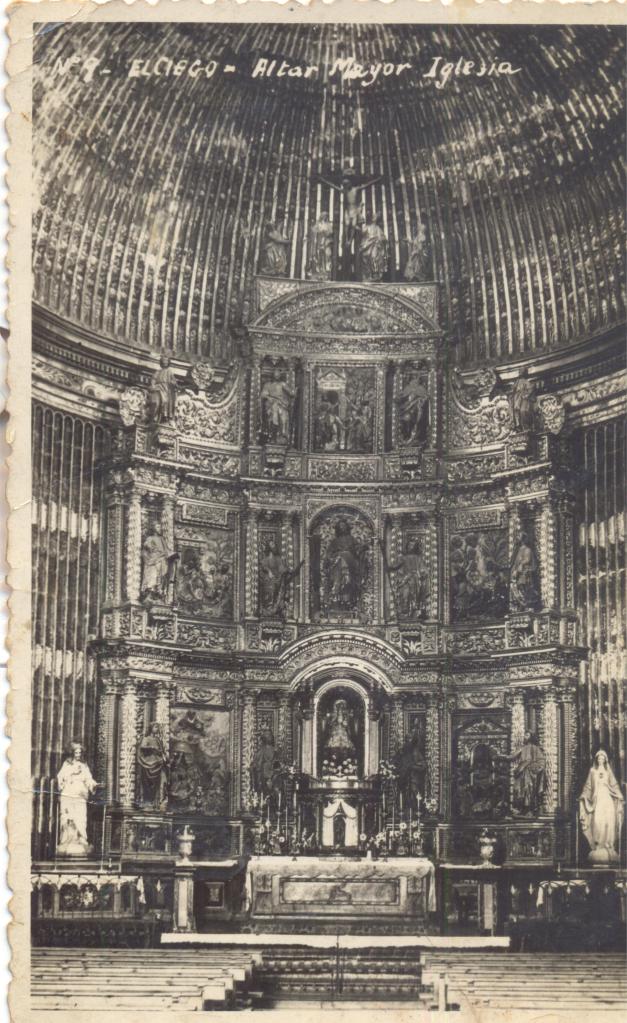
Probably, upon entering the temple, your gaze has been directed with curiosity to the head of the temple. It is a semicircular apse built entirely of gilded stone, fully fluted, which extends its decoration from the upper shell to the ground, producing an enveloping shell effect around the altarpiece. All this creates a striking and incomparable set.
This majestic altarpiece is from the early Baroque era, although it has important Renaissance influences. It was erected between the years 1646 and 1669. The altarpiece consists of a bench, three bodies and an attic, dividing into three streets and four small streets.
Let’s start at the bottom called bench. In it you can distinguish, among figures of various saints, the reliefs corresponding to the «Capture of Our Lord» and «the Fall of Jesus under the Cross». A beautiful tabernacle that occupies the heart of the bench, is adorned by the figure of Christ the Saviour flanked by those of Saint Peter and Saint Paul. They are, perhaps, the reliefs made more delicately of the whole.
In the first body, the image of Our Lady of the Rosary occupies the central tabernacle. On the left, there is the relief of «The Annunciation», between the carvings of Saint John and Saint Peter. Meanwhile, on the right, between the effigies of Saint Paul and Saint James Apostle we can see the relief of «The Nativity».
From left to right, in the second body, you can see the reliefs dedicated to «the Adoration of the Magi» and «the flight to Egypt», among the carvings of Saint James the Less, Saint Thomas, Saint Philip and Saint Bartholomew, while the figure of Saint Andrew, larger and with its classic cross in X, symbol of his martyrdom, occupies the central niche, presiding the altarpiece.Saint Andrew had the privilege of being the first apostle chosen by Jesus. For this reason, since ancient times it was called Πρωτόκλητος Prōtoklētos, «the first called».
One of the two men who had heard John and had gone with Jesus was Andrew, the brother of Simon Peter. The first thing Andrew did was to find his brother and tell him, “We have found the Messiah!” The Hebrew word “Messiah” means the same as the Greek word “Christ.” Andrew brought his brother to Jesus. And when Jesus saw him, he said, “Simon son of John, you will be called Cephas.” This name can be translated as «Peter» John 1, 40-42
In the third and last part, the relief dedicated to «the Visitation of the Virgin Mary to her cousin Saint Elizabeth» is escorted by the carvings of Saint Mathew and Saint Simon, on the left, and by the sculptures of Saint Matthias, the apostle who replaced to Judas, and by an anonymous carving, to the right.
The attic is topped by a curved pediment, in whose tympanum is the figure of the Eternal Father with a sphere in his hands. Above him, crowning this impressive altarpiece, we can see the representation of «Calvary»: Christ crucified accompanied by Mary, his mother; Saint John, the beloved disciple; Mary Magdalene and Mary of Clopas. It is an atypical iconographic composition with five figures, incorporated after the whole.
“Jesus’ mother stood beside his cross with her sister and Mary the wife of Clopas. Mary Magdalene was standing there too. When Jesus saw his mother and his favorite disciple with her, he said to his mother, “This man is now your son.” Then he said to the disciple, “She is now your mother.” From then on, that disciple took her into his own home.” John 19, 25-27
And in the lower part of this extraordinary altarpiece, the greatest treasure we can find in this temple, the Eucharistic Presence of the Lord in the Tabernacle, goes unnoticed. The living Christ has saved and redeemed us, has freely given us eternal life and is always at our side.
“Our salvation is a gift of the blood of Christ; everything is a free gift from God and his love for us”
We hope your visit was pleasant. Before leaving the temple following your path, we invite you to have a moment of recollection and prayer, to sit in silence before the welcoming presence of Our Mother, meditating on her life of dedication and gratitude, or simply praise and glorify the Lord in his presence in front of the Tabernacle.
(We put at your disposal some prayers and links that may help you in these moments of internalization. In the same way, you can learn more about the life of the Saints in the altarpiece thanks to the various links in the text.)
GOSPEL OF THE DAY / ROSARY / VIA CRUCIS / VIA LUCIS
For now there are faith, hope, and love. But of these three, the greatest is LOVE.
(1 Cor. 13, 13)
If you can much; much.
If you can little; a little bit.
If you can’t do anything; nothing.
WHEN YOU LEAVE THE CHURCH, MAKE YOUR DONATION
ST ANDREW’S PRAYER
O Glorious St. Andrew,
you were the first to recognize and follow the Son of God.
With your friend, St. John,
you remained with Jesus,
for your entire life,
and now throughout eternity.
Just as you led your brother, St Peter,
to Christ and many others after him,
draw us also to Him.
Teach us how to lead them,
solely out of love for Jesus
and dedication to His service.
Help us to learn the lesson of the Cross
and carry our daily crosses without complaint,
so that they may carry us to God the Almighty Father. Amen.
– – – – –
Brother of Simon Peter, you heard John the Baptist say: “Behold the Lamb of God,” and you chose to follow Jesus.
Leaving your nets, you became a successful fisher of souls.
Lover of the Crucified Christ, you too were crucified like him.
Teach us to live and suffer for Him and to win many souls for Christ. Amen.
PRAYER TO THE HOLY SPIRIT
Holy Spirit of light and love,
you are the substantial love of the Father and the Son;
hear my prayer.
Bounteous bestowed of most precious gifts,
grant me a strong and living faith
which makes me accept all revealed truths
and shape my conduct in accord with them.
Give me a most confident hope in all divine promises
which prompts me to abandon myself unreservedly to you and your guidance.
Infuse into me a love of perfect goodwill,
and act according to God’s least desires.
Make me love not only my friends but my enemies as well,
in imitation of Jesus Christ who through you offered himself on the Cross for all people.
Holy Spirit, animate, inspire, and guide me, and help me
to be always a true follower of you.
Amen.
 Iglesias de Álava/Araba